本日の気になる語法は
- whose job
に代表される関係代名詞の所有格の用法です。
日本の学習指導要領では、小中高全ての課程で関係代名詞の所有格が取り上げられることがありません。イヤ、ホントにないんですよ。
ということで、教科書であれ、何であれ、教材を作る際には関係代名詞の所有格を使わないで英文を執筆する、またはその代替表現を選択する、という「流れ」が主、つまり「主流」です。
私はこの「主流」が好きではありません。
頻度がいくら低い表現形式であっても、
- 「だって、所有格を使わざるを得ない環境があるでしょ?」
って思うから。
私の場合は、「英語ニュース引用RT140字紹介&詳解」をやっている関係上、英語ニュースを読む比率が高いのですが、一番多いと言えるのが「亡骸の発見や回収」「死者の発見に伴う調査や捜査」の文脈です。
An investigation is under way into the death of a woman whose body was found in Nenagh, Co Tipperary on Sunday
An investigation is under way into the death of a woman whose body was found in Nenagh, Co Tipperary on Sundayhttps://t.co/bGDcEfiyKe
— RTÉ News (@rtenews) 2024年8月6日
つながりとまとまりの観点でも、死亡した事実=死者の提示→死者の遺体に言及→その発見者、というような情報の流れが自然。
Police are searching the Maribyrnong River after deeming the death of a woman whose body was found in the water at Flemington as suspicious.
A passerby discovered the body yesterday morning, finding the woman floating in the river with her legs wrapped in plastic and a bag tied over her head.
The tragic finding was made just 90 minutes after the discovery of a man’s body in a nearby stretch of the river at Footscray.
Police are searching the Maribyrnong River after deeming the death of a woman whose body was found in the water at Flemington as suspicious.
— 10 News First Melbourne (@10NewsFirstMelb) 2024年7月15日
A passerby discovered the body yesterday morning, finding the woman floating in the river with her legs wrapped in plastic and a bag tied… pic.twitter.com/1zrQGG18y3
この所有格のwhoseは補足情報での挿入句としても使われるので、非制限的用法もあり、ということを確認しておきましょう。
Authorities said the woman, whose body was found in the Las Vegas Valley in 1979, left Ohio to find her biological father in California.
Authorities said the woman, whose body was found in the Las Vegas Valley in 1979, left Ohio to find her biological father in California. https://t.co/e8214tKQVy
— WPEC CBS12 News (@CBS12) 2024年8月10日
job以外に頻繁に見聞きするものとしてはlife/lives で、「生活・人生激変」のパターン。
Red Cross responders have helped almost 17 million people whose lives have been changed forever by the conflict in #Ukraine.
Red Cross responders have helped almost 17 million people whose lives have been changed forever by the conflict in #Ukraine.
— British Red Cross 🧡 (@BritishRedCross) 2023年10月2日
With your support, we’re here for anyone in crisis across Ukraine and 191 other countries.
Together, we are the world's emergency responders. pic.twitter.com/OgtAuHPvfu
We asked a few people whose lives have been changed if they would like to say a few words ❤️
Today marks the start of #VolunteersWeek and we simply wouldn’t be able to train as many hearing dogs, or help as many deaf people as we do, if it wasn’t for our volunteers.
— Hearing Dogs for Deaf People (@HearingDogs) 2023年6月1日
We asked a few people whose lives have been changed if they would like to say a few words ❤️ pic.twitter.com/fc9wFWHjxp
The animated documentary "Little Birds" features stories of children living at a shelter in Reynosa, Mexico, where we provide physical & mental health care to people whose lives have been uprooted.
The animated documentary "Little Birds" features stories of children living at a shelter in Reynosa, Mexico, where we provide physical & mental health care to people whose lives have been uprooted.
— Doctors w/o Borders (@MSF_USA) 2024年6月3日
Holding a crayon may allow them to access feelings they can't express in words. pic.twitter.com/FQrS5GxxcY
ということで、関係代名詞の所有格は現代英語でも重要な役割を果たしていることが見て取れたと思います。
その中で、私が気になっているのは「仕事が…な人(人々)」でのwhose の後に続く表現。
They view the WTO as an important inetergovernmental body supported by a small (and hardworking) secretariat whose job is to facilitate nation-state to nation-state dialogue.
彼らはWTOを、国民対国家の対話を促進することを仕事とする、小さな(そして勤勉な)事務局に支えられた重要な政府間機関だと考えている。
この例では、名詞+whose job is to原形、となっています。
これに対して、次の例では、
The Spanish monopoly of chocolate was officially broken in 1615 when Anne of Austria, daughter of Philip II of Spain, married King Louis XIII of France. She brought the secret of chocolate with her from Spain, together with her maid, whose job it was to prepare the royal chocolate.
1615年、スペイン王フィリップ2世の娘であるアンヌ・ドートリッシュがフランス王ルイ13世と結婚したことにより、スペインによるチョコレートの独占は正式に解かれた。彼女はスペインからチョコレートの秘密を持ち帰り、王室御用達のチョコレートを作ることを仕事としていたメイドも連れてきた。
のように、名詞+whose job it is to原形。
辞書の用例や定義でも、itのある形とない形が混在。
A person whose job is to sing and dance is called an entertainer.
歌ったり踊ったりするのが仕事である人は芸能人と呼ばれる (Wisdom)
...the tiny U.N. observer force whose job it is to police the border.
国境警備が任務の小規模な国連監視部隊 (COBUILD 米語英英和)
For example, a psychoanalyst is someone whose job is to talk to people in order to help them to understand their behaviour or mental problems. (COBUILD)
OALDでは、定義での言い換え表現で頻出。
a consumer watchdog (= somebody whose job is to protect consumers’ rights)
a make-up artist (= a person whose job is to put make-up on the faces of actors and models)
a safety officer (= somebody whose job is to ensure safety)
定義文の精緻さで定評のあるCACDでも
a person in an aircraft whose job is to serve passengers and to make sure they obey safety rules
itの有無が気になると思いますが、これは下敷きになっている英語表現が異なるからですね。
a. His [Her] job is to ensure safety. 彼[彼女]の仕事は安全を確保することだ。
b. It is his [her] job to ensure safety. 安全を確保することが彼[彼女]の仕事だ。
b.の it は形式主語として使われていて、不定詞がその種明かしの焦点化表現です。
どちらの<所有格+名詞>が関係詞として括り出されたかの違いが、表面上の違いとなっています。
私自身は、aのパターンの表現しか使わないので、bのitには違和感がありますが、この関係詞の所有格の表現形式で、名詞がjobの場合は、現代英語ではitのある方が優勢のようです。
では、関係代名詞の所有格で、不定詞が続いて定義する場合は一律にitのある形式が優勢なのか?というとそうとも言えないのですね。
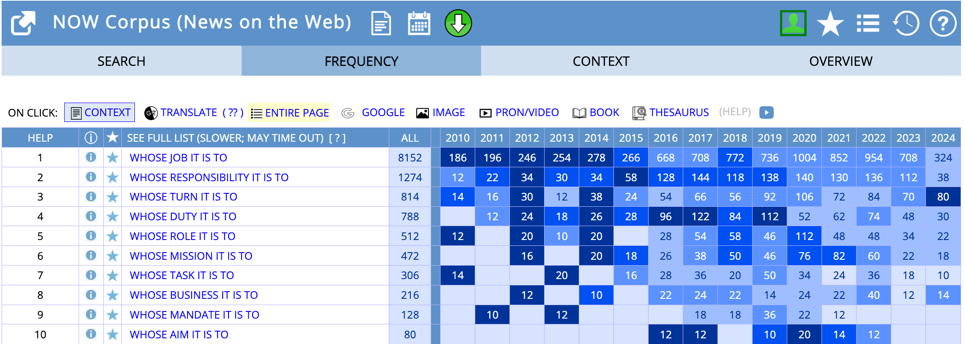
NOWでitあり。
NOWでitなし。
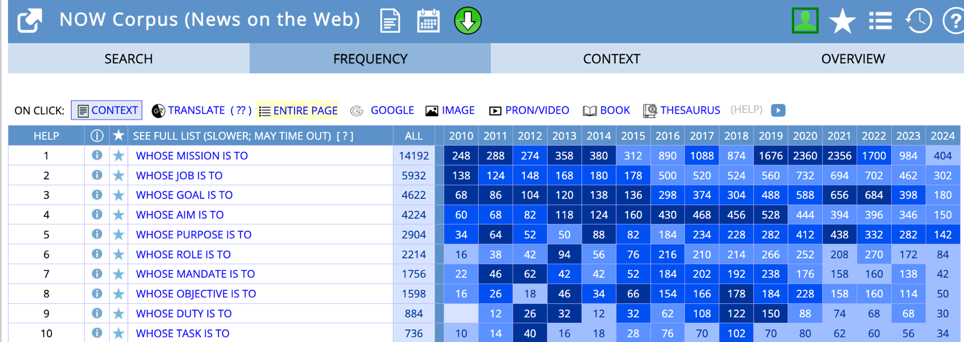
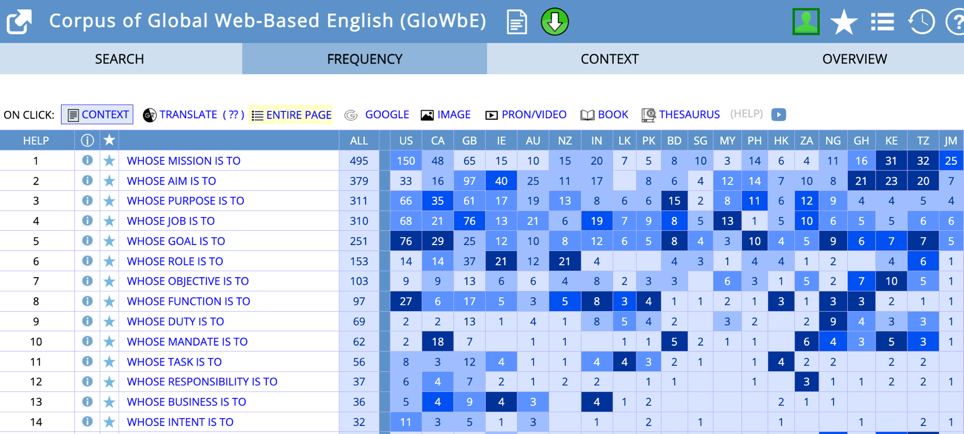
名詞によって一概には言えないことが分かろうかと思います。
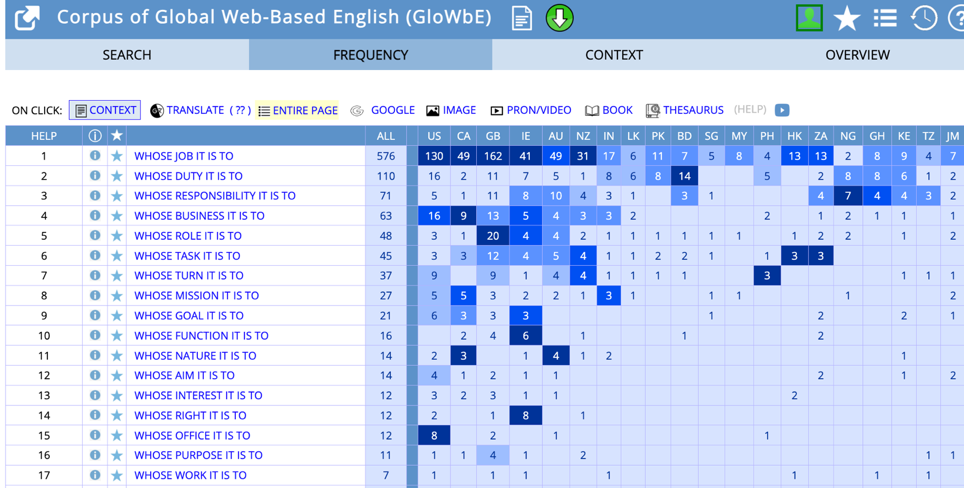
Glowbeでitあり。
Glowbeでitなし。
COCAでitあり。
COCAでitなし。

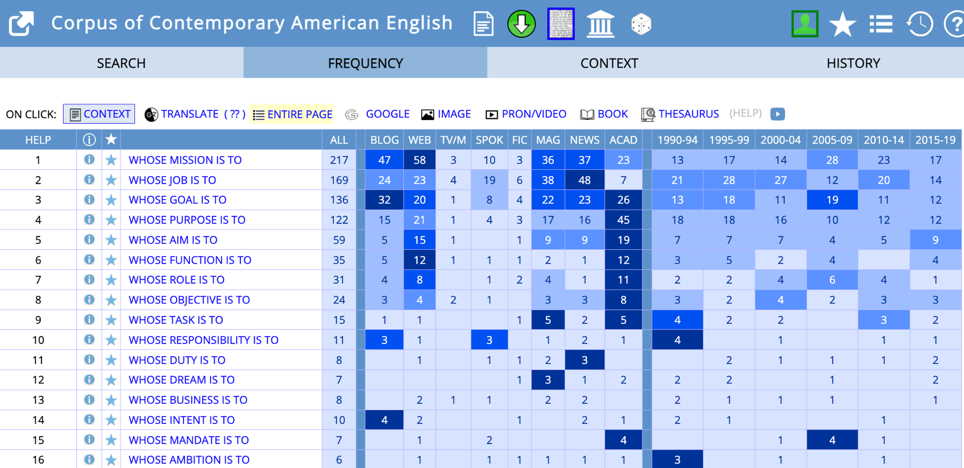
名詞jobだと、 it あり:itなし=315:169 でダブルスコアに近い差です。
でも、名詞missionだと、itあり:itなし=11:217 で20倍くらいになります。
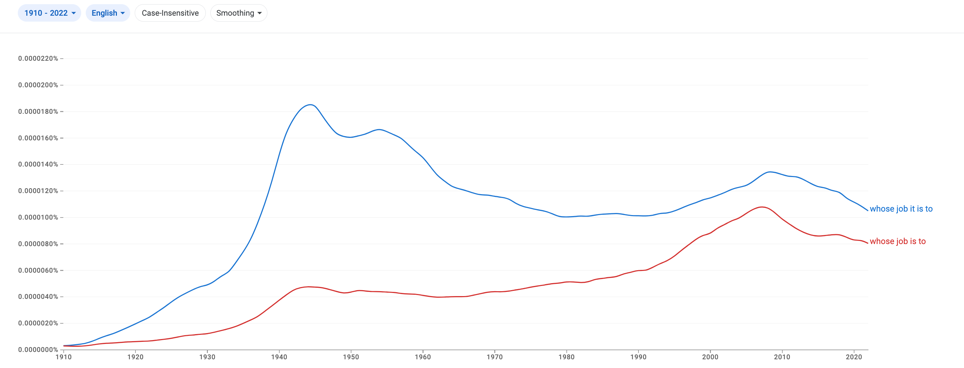
主立った名詞をNgram Viewerで見ておきましょう。
全
米
英
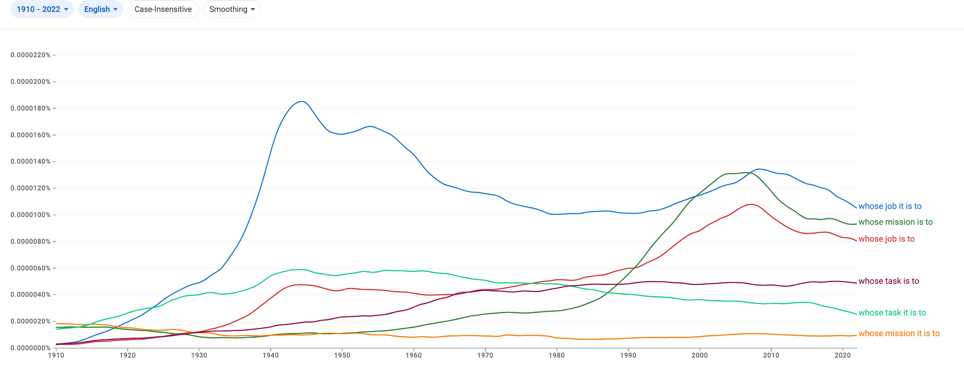
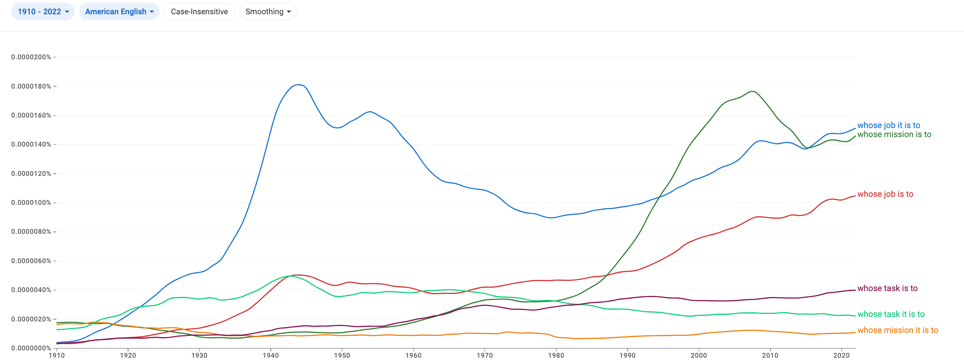
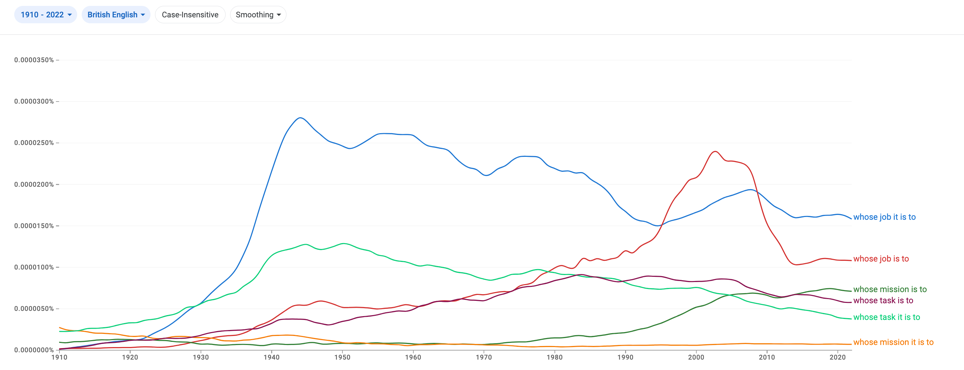
名詞によって、年代によって変化が大きいように思います。
時系列でこの約100年を設定した目論見としては
1910年代 第1次世界大戦前後
1920年代末から 世界恐慌前後
1940年代 第二次世界大戦前後
1970年代 ベトナム戦争とオイルショック前後
1990年代 インターネット普及の前後
2000年代末から リーマンショック前後
2020年代 コロナ禍前後
で仕事関係には大きな影響が出ているのではないか、と思ったから。単純に個人の思惑です。
このグラフを見ても、itのあるなしで単純な一般化は難しいことが分かるのでは、と思います。
文化差、個人差など考慮すべきことは、この検索結果の奥にあることでしょう。
COCAの検索結果を効果的に切り貼りするだけの簡単な仕事、などと思わず、普段から、英語表現を一つ一つ丁寧に見ていくことが大事だと、肝に銘じます。
本日はこの辺で。
本日のBGM: There’s somebody whose job it is (Josh Rouse)
