はじめに
Rustでファミコンのエミュレータを写経していた時のお話です。CPUの実装で加算・減算の命令実装時に、オーバーフローの判定を挟むのですが何やっているのか分からず悩んだので、ここに自分なりの解釈を書いておきます。もっと良い考え方があれば教えてください。
問題の箇所
このリポジトリのこの箇所です。
pub fn adc_imm<T: CpuRegisters>(operand: Word, registers: &mut T) {
    let computed = (operand as u16) + registers.get_A() as u16 +
                   bool_to_u8(registers.get_carry()) as u16;
    let acc = registers.get_A();
    registers
        .set_overflow(!(((acc ^ (operand as Data)) & 0x80) != 0) &&
                      (((acc ^ computed as Data) & 0x80)) != 0) //  ココ
        .update_negative_by(computed as Data)
        .update_zero_by(computed as Data)
        .set_carry(computed > 0xFF)
        .set_A(computed as Data);
}

// [引用] https://github.com/bokuweb/rustynes/blob/f213881554e20054c7ea7adafe511195c25f8cb7/src/nes/cpu/instructions.rs#L147
前提知識
ざっくりまとめると
- ファミコンでは演算時に値を
Signed Intとして扱っているはずである。 - このメソッドは
u8のoperandとaccの2つの変数の足し算。(正確には1か0のcarry_flagも足している) - ファミコンにおいてもし結果がオーバーフローしていたらそれを検知する必要がある。
!(((acc ^ (operand as Data)) & 0x80) != 0) && (((acc ^ computed as Data) & 0x80)) != 0がtrueなら、オーバーフローしてる判定らしい
オーバーフロー検知
分解
まず判定式を2つに分けてみます。
!(((acc ^ (operand as Data)) & 0x80) != 0)(((acc ^ computed as Data) & 0x80)) != 0
1では1つ目の変数と2つ目の変数をxorした後に、0x80でANDを取っています。よく分からないので更に分解してみます。xorとandで分配則が成り立つはずなので、分解します。ついでに先頭の!も取ります。
- (acc & 0x80) ^ (operand & 0x80)が==0
http://markun.cs.shinshu-u.ac.jp/learn/logic/logic3/html/jp/fnd4-j.html
判定
0x80とandをとることで、8bit目が1かどうか判定してます。これにより値の正負を判定できます。(正なら0x80, 負なら0x00)- 上の結果を
xorすることにより、元の2変数の正負が同じであった場合のみ0が算出されます。(正:0x80 ^ 負:0x00 = 0x80, 正^正= 0x00) - つまり1では、
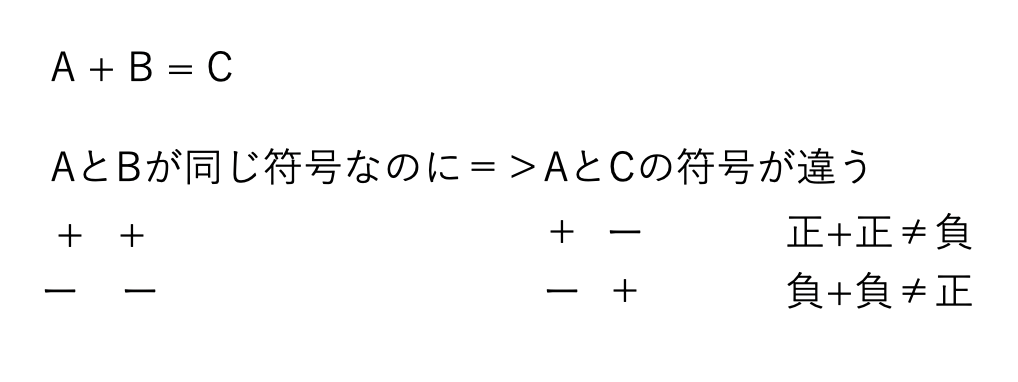
足した2変数が同じ符号であったかを見てます。
これらを踏まえると2では、変数1と演算結果が違う値かを判定していることになると思います。
つまり?
足し算なのに結果の正負が変わることはないよ。変わっていたら、お前オーバーフローしてね?ってことだと思います。
減算も見てみる
手短に引き算も見ます。
pub fn sbc_imm<T: CpuRegisters>(operand: Word, registers: &mut T) {
    let computed = registers.get_A() as i16 - (operand as i16) -
                   bool_to_u8(!registers.get_carry()) as i16;
    let acc = registers.get_A();
    registers
        .set_overflow((((acc ^ (operand as Data)) & 0x80) != 0) &&
                      (((acc ^ computed as Data) & 0x80)) != 0) // ココ
        .update_negative_by(computed as Data)
        .update_zero_by(computed as Data)
        .set_carry(computed >= 0 as i16)
        .set_A(computed as Data);
}

// 引用: https://github.com/bokuweb/rustynes/blob/f213881554e20054c7ea7adafe511195c25f8cb7/src/nes/cpu/instructions.rs#L174
rustynes/instructions.rs at f213881554e20054c7ea7adafe511195c25f8cb7 · bokuweb/rustynes · GitHub
日本語に直すと、変数1と変数2の符号が違っているのに変数1と演算結果も符号が違うとなりそうです。これは式が
A - (B) = C
であることに注意すれば、足し算と同じように理解できそうです。
