السلام عليكم,
أنا مدونة يابانية. درستُ الدبلوماسية، لذا فأنا من مُحبي السلطان قابوس.
زرتُ عُمان لأول مرة الأسبوع الماضي. زرتُ مسقط، ونزوى، وصلالة، وخصب.
وازداد حبي لعُمان أكثر فأكثر.
يا أهل عُمان، بلدكم هو الأجمل في العالم، يجب أن تدركوا ذلك!!
Phew, that's the limit of my poor Arabic skills. From now on, I'll have to write in English, unfortunately.
I'm Kayano, a blogger who usually writes in Japanese. But this time, I really wanted to reach out to Omanis and other English speakers, so I will write in English and a little bit of Arabic.
During this time, I have travelled to Muscat, Nizwa, Salalah, and Khasab, and would like to share my impressions.
- About me
- Why Oman?
- HM Sultan Qaboos: My Ultimate Monarch
- My political views in brief
- Purpose of the Trip
- Omanis are extremely KAWAII
- «ونحن أصدقاء للجميع»
- So, let’s calm down for a moment…
- Afterword
About me
Let me start by giving a brief introduction.
I am a Tokyo-based Japanese blogger in my mid-20s. During my university years, I was deeply involved in the Model United Nations, where I specialized in Arab diplomacy. Notably, I was the pioneer who organized the first-ever Model League of Arab States conference in the history of Japan MUN. My track record includes serving as a director for conferences focusing on Palestine, Western Sahara, and Iraq.
Currently, I am a supporting member of the Middle East Institute of Japan and a passionate observer of Arabic and Islamic culture.
I studied Arabic for a year at university, but unfortunately my department didn't allow me to continue studying it (I was actually enrolled in the French Literature Department, lol).
Of all the Arab countries, I've only been to Egypt, and this is my first time visiting the Gulf, although I often transit through Dubai.
Why Oman?
I was really looking forward to this trip. I've studied all 22 countries of the League of Arab States, but honestly, Oman is by far my favorite. Has anyone who has studied the diplomacy around the world not fallen in love with Oman?
If you've studied the politics of Arab countries even a little, you'll know what I mean.
Yes, former Sultan Qaboos bin Said's 50-year reign was TRULY impressive.
HM Sultan Qaboos: My Ultimate Monarch
"Before he ascended to the throne, there were only three schools, two public hospitals, and 15 kilometers of paved roads in the entire country." — This is the legendary opening line whenever his achievements are told.
His life was more dramatic than any manga: placed under house arrest by his own conservative father, he eventually took the lead in a bloodless coup to save his nation. For 50 years, he navigated the complex geopolitics of the Middle East—bordered by Saudi Arabia, the UAE, Yemen, and Iran across the Gulf—turning Oman into a beacon of safety and neutrality. He is, without a doubt, the greatest monarch of the 20th and 21st centuries. Of all the monarchs in history, he is my absolute favorite.
But my respect isn't just academic; I have personally benefited from his grace.
In Tokyo, there is a Middle Eastern studies course supported by Sultan Qaboos. Thanks to his vision, this portal of knowledge is open to everyone for free. I was one of those students who frequented these lectures, and it was there that I had the invaluable chance to engage in deep discussions with researchers specializing in Palestine, the UAE, Jordan, and Oman.
To this day, the Sultan Qaboos Rose—a gift from the Omani Ambassador—blooms quietly within the University of Tokyo. It’s a hidden gem, not a typical tourist spot, so it may be difficult to access, but if you ever find yourself in Tokyo, I urge you to seek it out.
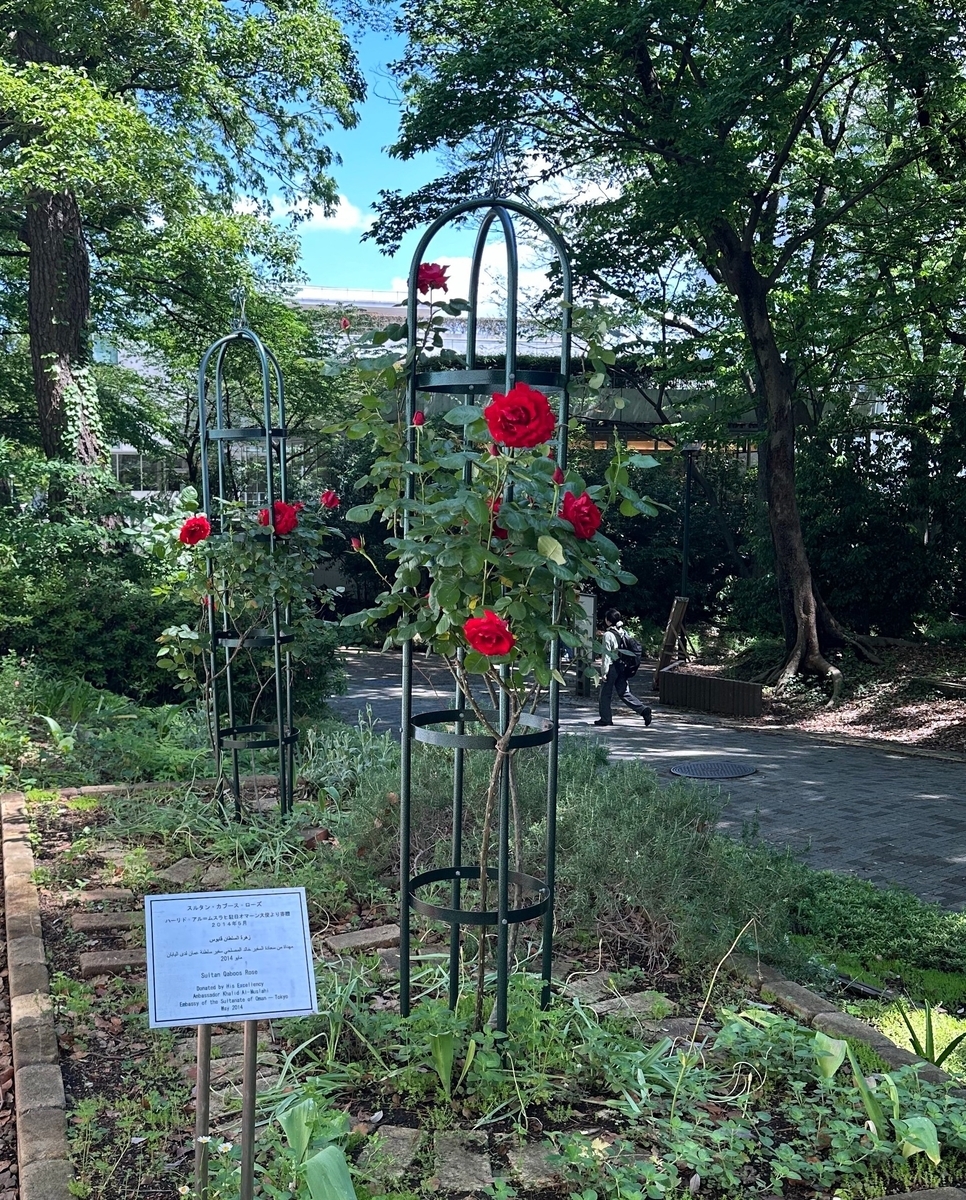
↑ From: The University of Tokyo Centre for Middle Eastern Studies, Sultan Qaboos Chair in Middle Eastern Studies
My political views in brief
I'm neither a complete democrat nor a monarchist. What I value is "who governs and on what basis," and I believe that methodologies should be chosen appropriately to suit the situation.
Japan is a democratic nation (though Japanese politics are quite poor), so if I were to defend an absolute monarchy, I might be considered a weirdo.
But think about it—do you really think democracy could have been established in Oman at the time, when there were only two hospitals and three madrassas? That's a far too fanciful idea. It can be said that developing under the strong leadership of the Sultan was the optimal solution for Oman. Oman is fortunate to have been blessed with such a wise ruler.
أنا أغار من العُمانيين, أريد أن يناديني السلطان بـ ܦ أبناء عُمان المخلصين ܧ أيضاً! هههه
If the rule of Sultan Qaboos, one of the greatest kings in history, did not make Oman a great nation, then it shows that the very idea of monarchy is flawed.
In ancient China, there was a thinker named Mencius, who advocated a political philosophy known as "virtuous governance."
This idea states that "rather than laws or punishments, the monarch's personal virtue should invigorate the goodness in every citizen and guide the nation."
I consider Sultan Qaboos to be a virtuous leader rather than an enlightened despot. Don't you agree?
Yes, virtuous governance is not an idea that can be realized anywhere and at any time. This is because to realize virtuous governance, the monarch must always possess boundless intelligence and goodness.
Furthermore, because the entire state depends on the monarch alone, there is a high possibility that the state will collapse when he dies.
However, Oman overcame this difficult challenge brilliantly. First of all, Sultan Qaboos can be said to be a monarch endowed with great wisdom and virtue. Furthermore, in accordance with Article 6 of the original Basic Law of Oman, he appointed Haitham bin Tariq as his successor. And now, under the new Sultan's rule, Oman has enjoyed a stable and orderly state for six years.
This fact shows that virtuous governance is not just an idealistic fantasy, but can actually be realized. I was deeply shocked when I heard of Sultan Qaboos' demise, but seeing the swift and peaceful transfer of power to His Majesty Sultan Haitham only strengthened my respect for him.
If Plato (a thinker on the "philosopher-king", needless to say) or Mencius were to meet Sultan Qaboos in the afterlife (though they might be in different corners of heaven, given their different faiths, lol), they would surely rush to him, eyes sparkling with excitement, asking for a handshake.
They would see in him the living proof that their "idealistic fantasies" weren't fantasies at all, but a reality that could be achieved through the sheer will and virtue of one man.
Purpose of the Trip
The purpose of this journey was not just to tick off tourist attractions, but to experience HIS country with my own eyes. I traveled to Oman to seek the answer to a singular, profound question: "Is virtuous governance truly possible on this earth? Can a nation shaped by a single, great monarch for 50 years be genuinely 'GOOD'?"
Having studied the politics of Arab states for years, I had built a very favorable image of Oman. Yet, a part of me remained skeptical—I feared it might only be a "utopia on paper."
However, my fears were utterly unfounded. Having walked its streets and met its people, I can now declare: Oman is, without a shadow of a doubt, the most magnificent country I have ever visited.
Omanis are extremely KAWAII
The thing that impressed me the most on this trip was the people: the Omanis.
Perhaps due to the influence of Arabic-Islamic culture, even though I am a woman, I did not have many opportunities to interact with local women (I would be happy to have the chance to become closer to them in the future), but I was particularly impressed by the men.
They are very kind, clean, smell nice, have gentle smiles, and speak English fluently. What more could we ask for? It's not uncommon for Japanese men to be sweaty and arrogant, so it's a huge culture shock. While I was being treated with halwa and qahwa in Muscat, serious discussions were taking place on Japanese Twitter about whether it was okay to split the bill at Japan's cheapest chain restaurant on a first date. Hey, can someone please enlighten these parochial islanders??
I am planning to spread the word about Oman in Japan to support the tourism industry in Oman, but I would not recommend this to women who are thinking of getting married in Japan, because if they come to Oman and their values are enlightened, it is clear that their plan will be ruined, lol.
Omanis are extremely kawaii. Let me explain: The Japanese word kawaii translates to "cute" or "pretty" in English, so if we use it with a man, he might be offended, thinking, "I'm not that childish or feminine."
However, kawaii is a uniquely Japanese expression that's difficult to translate into other languages, and it can mean "lovely," "charming," and "sympathetic." We Japanese people, especially young women, even casually call older men kawaii. It's just a compliment. Don't scold us until we start calling even God or a prophet kawaii, lol (Even from a Japanese perspective, that would be considered disrespectful.)
Each of them wore clean, crisp dishdashas, and from their frakha tassels wafted the exquisite scent of their respective perfumes. In Japan, saying “ojisan (middle-aged man)'s smell” is 100% an insult, but in Oman, saying "عبير الرجال" is a compliment. This is, after all, The Land of Frankincense! I can't believe it.
Their hospitality is warm without being intrusive, and when I express their gratitude they smile shyly. WHAT'S GOING ON? Isn't it too kawaii???
It wasn't just one person in particular, but without a single exception, all the Omanis and even immigrants I came into contact with on this trip were friendly towards me. This is truly what we could call national character.
I don't know if this is something unique to Arabs, or a result of the Gulf region, or the influence of Islam, or the influence of the Ibadi sect. Still, if it was the influence of Sultan Qaboos, then it is the perfected form of virtuous governance. The concept of virtuous governance, which originated in ancient China, may have been realized in modern Oman.
«ونحن أصدقاء للجميع»
During this trip, I encountered neither racism nor sexism at all. However, one encounter in Muscat left a profound impression on me.
At a restaurant, a worker of Southeast Asian descent asked me, "Where are you from?"
"Japan, Tokyo," I replied.
She looked at me and said, with a hint of sarcasm, "We were once enemies."
It was the first time I had been confronted so directly with that historical reality. I was momentarily taken aback, but she was right. Our crazy ancestors did indeed run wild across Asia, you know. Though I was born in 1998 and have no direct hand in those shadows, she has every right to criticize the legacy they left behind.
After this exchange, my admiration for Omani diplomacy reached a new peak. When Omanis travel abroad, they are almost never met with such words. Unless they happen to encounter an extreeemely resentful Portuguese historian, or perhaps those from Zanzibar and Gwadar who still carry the scars of the old slave trade, Oman’s modern ledger is remarkably clean.
Hey, world! Isn't this what true politics is all about? Isn't this the ultimate goal of a nation—to allow its citizens to walk anywhere on Earth with their heads held high, unburdened by the animosity of others?
Shortly after I left Muscat, negotiations between the United States and Iran were underway in the city. Iran specifically requested Oman for this role—a testament to the Sultanate's unwavering track record of trust.
As Oman’s Foreign Minister elegantly put it:
«ونحن أصدقاء للجميع، ونظل مخلصين حقا لهذا المبدأ.»
(We are friends to all, and we remain truly loyal to this principle.)
Simply magnificent.
Meanwhile, back in my Far-Eastern island nation, a snap election was held on a chaotic schedule (which, to my fury, prevented me from voting), resulting in a landslide victory for a far-right government. It seems they are eager to rewrite the constitution and prepare for war.
While His Majesty Sultan Haitham sent a gracious congratulatory telegram to our Prime Minister, I can't help but feel a pang of regret that such noble diplomacy is wasted on politicians with such antithetical views.
In Stendhal's La Chartreuse de Parme, there is a memorable line: "Régnez sur moi et sur mes États (Please govern me and govern my country!)."
—Well, if I say any more, I’ll lose my reputation as a level-headed political critic, so I shall stop here, lol.
So, let’s calm down for a moment…
Having traveled around Oman for a week, I honestly couldn't find a single flaw with my enamored eyes. Is love simply blind? Is the grass always greener? I kept asking myself: "Where are the cracks in this desert miracle?"
To reassure my level-headed Western readers (and to prove I’m not an Omani state agent, lol), let’s get serious. Oman faces undeniable challenges: an oil-dependent economy, a struggling job market for the youth, strict censorship, the restrictive path to citizenship, the complex issues surrounding migrant labor the retention of the death penalty, and a lack of legal protections for LGBTQ+ individuals.
However, let’s look closer.
Based on my observations on Omani Twitter, policy criticism—excluding the Royal Family—is surprisingly more vibrant and substantive than in Japan. (Honestly, why does Japan even bother calling itself a "democracy" anymore?) The recent public forums where cabinet ministers engaged directly with the youth were genuinely impressive.
As for the economy, Oman has deliberately steered away from the "Dubai model." This is a marathon, not a sprint. We must judge its success over the long term. There is a trade-off between rapid economic growth and fostering a moderate and peaceful national character.
I understand that Dubai’s economic meteoric rise is nothing short of spectacular. It was incredibly insightful to bet all of our limited oil resources on sustainable tourism and finance. I can also see why Doha, Riyadh, and Manama are so eager to follow in its flashy footsteps.
However, for a tourist from a faraway region, cityscapes that are conscious of the traditions and harmony of the region are more interesting. To be honest, as a tourist, I was more impressed by the warm smiles of the people than by the tallest tower.
And from a diplomatic standpoint (sorry for confusing the topic, but let me limit my focus there to avoid too much trouble, lol), it is Oman that stands as the most sophisticated and superior. To me, it is a genuine mystery why more nations don't strive to emulate the "Omani model".
Is it because "virtuous neutrality" is less profitable than "grand spectacles"? Or is it simply because the Omani path requires a level of patience and wisdom that is far rarer than oil or natural gas?
Obtaining citizenship and navigating immigration remain structural challenges across the Gulf. In Oman, even the migrant workers greeted me with gentle smiles, yet the lingering shadows of the Kafala system cannot be ignored.
As a MUNer (in other words, from the perspective of simulating national administration), I understand that this kind of "carrot and stick" policy is "effective," but from a human rights perspective, I cannot fully defend it.
Let us recall that in 1970, Sultan Qaboos granted citizenship to the Al-Lawatia and Banians who were living in Oman at the time.
Regarding the death penalty and sexual minority rights, these are deeply intertwined with Sharia law, making rapid change difficult. Yet, Oman maintains a relatively low execution rate through careful judicial restraint (according to Article 40 of the Penal Code and Articles 221 and 288 of the Criminal Procedure Code). And before anyone points fingers: Japan, too, is a retentionist state. But while Oman’s stance is rooted in faith, Japan’s is rooted in a collective apathy toward human rights.
Still, in all honesty, compared to my own Far-Eastern island nation, which seems to be in a graceful downward spiral, these "flaws" feel like minor hurdles. (Forgive me, we Japanese are a self-deprecating bunch, lol.)
So, did you believe I'm not an agent?
Well, after staying in Salalah, I had a crazy itinerary that took me from Salalah International Airport to Dubai, then from Al-Darah border gate to the Musandam Peninsula, and then back to the UAE in a day, all within 24 hours, so UAE immigration officers indeed suspected me of being an Omani smuggler...
I am just a passionate otaku (nerd), يا Officers and dear readers!
الله يحفظ عُمان!
Afterword
I've just returned from my trip, so I couldn't help but write a passionate love letter, lol. Apparently, I wrote over 2500 words. I hope it doesn't put you off...
If you have any thoughts, I'd appreciate it if you could kindly point them out. Thank you.
Next time, I'd like to write a brief summary of my trip, with some photos.
Until then, stay curious and stay safe. See you in the next report!
