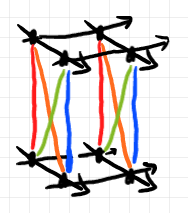
「ピンとこない」「自分の直感に反する」「つかみどころがない」「意味がハッキリしない」などの感覚を持つ理由のかなりところ(大部分かも知れない)は、
- 具体的な作業をした経験がない
このようなとき、「具体的な作業をしなさい〈get your hands dirty〉」がお説教の決まり文句だが、そう言われても、
- 具体的な作業の仕方が分からない
ここで、トレース〈対角和〉に関して「具体的な作業」の事例を示す。このテの作業は時間がかかり過ぎると思うだろうが、長期的・結果的に見れば、もっとも短い時間で無駄なく理解に至る手法だと思う。具体的な作業を避けたいならば、より効率的な理解法・学習法を編み出さなくてはならない(僕は知らない)。
「トレースを計算する」にて:
完全なストランド図をそれなりに精密に頑張って描くとかも効果がある。
ストリング図ではなくて、ストランド図を描く。$`\require{color}
\newcommand{\redA}{\textcolor{red}{a}}
\newcommand{\greenB}{\textcolor{green}{b}}
\newcommand{\greenB}{\textcolor{green}{b}}
\newcommand{\orangeC}{\textcolor{orange}{c}}
\newcommand{\blueD}{\textcolor{blue}{d}}
\newcommand{\I}{\mathrm{I}}
\newcommand{\Idx}[2]{ {\scriptsize \begin{pmatrix} #1 \\ \downarrow\\ #2\end{pmatrix} } }
%`$
$`
A = \begin{array}{c|cc}
& 1 & 2 \\
\hline
1 & \redA & \greenB \\
2 & \orangeC & \blueD
\end{array}\\
\:\\
\I = \begin{array}{c|cc}
& 1 & 2 \\
\hline
1 & 1 & 0 \\
2 & 0 & 1
\end{array}
`$
$`A`$ と $`\I`$ をストランド図(ストランド方向は上から下)で描くと:
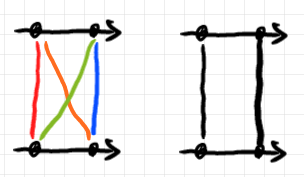
$`A`$ と $`\I`$ のテンソル積を作る。箇条書きの番号は「1から4」を4回繰り返している。
- $`(A\otimes \I)\Idx{1, 1}{1, 1} = A\Idx{1}{1}\I\Idx{1}{1} =\redA`$
- $`(A\otimes \I)\Idx{1, 1}{1, 2} = A\Idx{1}{1}\I\Idx{1}{2} = 0`$
- $`(A\otimes \I)\Idx{1, 1}{2, 1} = A\Idx{1}{2}\I\Idx{1}{1} =\orangeC`$
- $`(A\otimes \I)\Idx{1, 1}{2, 2} = A\Idx{1}{2}\I\Idx{1}{2} = 0`$
- $`(A\otimes \I)\Idx{1, 2}{1, 1} = A\Idx{1}{1}\I\Idx{2}{1} = 0`$
- $`(A\otimes \I)\Idx{1, 2}{1, 2} = A\Idx{1}{1}\I\Idx{2}{2} = \redA`$
- $`(A\otimes \I)\Idx{1, 2}{2, 1} = A\Idx{1}{2}\I\Idx{2}{1} = 0`$
- $`(A\otimes \I)\Idx{1, 2}{2, 2} = A\Idx{1}{2}\I\Idx{2}{2} = \orangeC`$
- $`(A\otimes \I)\Idx{2, 1}{1, 1} = A\Idx{2}{1}\I\Idx{1}{1} = \greenB`$
- $`(A\otimes \I)\Idx{2, 1}{1, 2} = A\Idx{2}{1}\I\Idx{1}{2} = 0`$
- $`(A\otimes \I)\Idx{2, 1}{2, 1} = A\Idx{2}{2}\I\Idx{1}{1} = \blueD`$
- $`(A\otimes \I)\Idx{2, 1}{2, 2} = A\Idx{2}{2}\I\Idx{1}{2} = 0`$
- $`(A\otimes \I)\Idx{2, 2}{1, 1} = A\Idx{2}{1}\I\Idx{2}{1} = 0`$
- $`(A\otimes \I)\Idx{2, 2}{1, 2} = A\Idx{2}{1}\I\Idx{2}{2} = \greenB`$
- $`(A\otimes \I)\Idx{2, 2}{2, 1} = A\Idx{2}{2}\I\Idx{2}{1} = 0`$
- $`(A\otimes \I)\Idx{2, 2}{2, 2} = A\Idx{2}{2}\I\Idx{2}{2} = \blueD`$
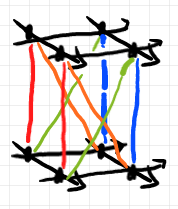
結果を表にまとめる。
$`A\otimes \I = \begin{array}{c|cc}
& (1,1) & (1,2) & (2, 1) & (2, 2)\\
\hline
(1,1) & \redA & 0 & \greenB & 0 \\
(1,2) & 0 & \redA & 0 & \greenB \\
(2,1) & \orangeC & 0 & \blueD & 0 \\
(2,2) & 0 & \orangeC& 0 & \blueD \\
\end{array}
`$
表を見ながら、$`A\otimes \I`$ をストランド図で描くと:
上下に $`\wedge`$ と $`\vee`$ を結合すると:
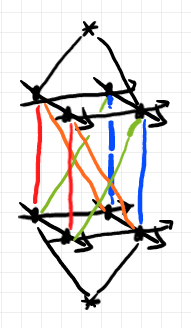
行列・テンソルの結合は、ストランドを繋いだパスの和を取ること。ゼロになるパスは描かないことにすると:
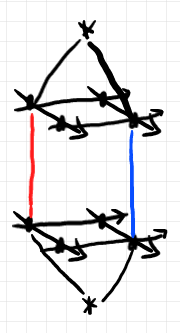
残る結果は実際にトレース〈対角和〉であることが分かる。
$`\quad
\mathrm{tr}(A) = 1\redA 1 + 1 \blueD 1 = \redA + \blueD
`$
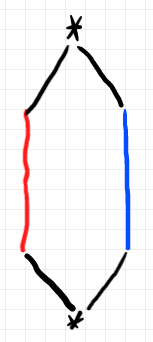
後知恵から、$`(A\otimes \I)\Idx{1, 1}{1, 1}`$ と $`(A\otimes \I)\Idx{2, 2}{2, 2}`$ の値以外は不要だったと分かるが、その後知恵も作業の過程と結果から得られる知恵。
ところでどうでもいいが、$`A\otimes \I`$ のストランド図は、見る方向(または番号の付け方)を変えて次のように描いたほうが見やすかったな、と。