前回エントリでリンクしたAEA予稿集から、今回は表題の論文を紹介してみる(1年前のWP)。原題は「Miracle or Myth? Assessing the Macroeconomic Productivity Gains from Artificial Intelligence」で、著者はFrancesco Filippucci(OECD)、Peter Gal(同)、Matthias Schief(同)。
以下はその要旨。
Artificial Intelligence delivers large productivity gains in specific tasks, but its impact on aggregate productivity remains debated. This paper discusses the drivers of micro-level AI gains and develops a micro-to-macro framework to predict aggregate productivity gains, arguing that AI could contribute between 0.3-0.9 percentage points to annual TFP growth over the next decade. Our micro-to-macro approach proceeds in two steps. In a first step, we follow Acemoglu (2025) and combine estimates of task-level productivity gains with measures of exposure of different tasks to AI and with projections for AI adoption rates to predict sectoral productivity gains from AI. This step reveals that AI-driven productivity gains will likely differ strongly across sectors; we predict that cumulative total factor productivity gains over the next decade could range from a low 0.1 pp. of additional growth in manual-intensive activities (agriculture, fishing, mining) and up to 3 pp. growth effect in knowledge-intensive services (Information and Communication Technologies, finance, professional services), driven by sectoral heterogeneity in exposure and also depending on the projections for future AI adoption rates. The pronounced sectoral heterogeneity in expected productivity gains form AI will likely have implications for the sectoral composition of the economy. Aggregate productivity growth could be limited by a Baumol effect if the sectors with the lowest productivity gains grow as a share of GDP. In a second step, we therefore account for the role of AI-driven structural change by aggregating sectoral productivity gains using a multi-sector general equilibrium model, building on Baqaee and Farhi (2019), that allows for sectoral reallocation of factors and adjustments in sectoral relative output prices. We find that sectoral differences in AI-driven productivity growth could diminish aggregate productivity gains through the Baumol effect, especially if elasticities of substitution in consumption across sectors are low and factor reallocation is limited.
(拙訳)
人工知能は特定の業務に大きな生産性の利得をもたらすが、総生産性への影響は未だに議論されている。本稿はミクロレベルでのAIの利得の要因を論じ、総生産性利得を予測するためのミクロからマクロへの枠組みを構築して、今後10年間にAIは年間TFP成長に0.3-0.9%ポイント寄与し得る、と主張する。我々のミクロからマクロへの手法は2段階で進められる。第一段階で我々は、アセモグル(2025*1)に従って、業務レベルの生産性利得の推計値を、AIの各種業務への影響度の指標ならびにAI導入率見通しと組み合わせ、部門別のAIによる生産性利得を予測した。この段階では、AIによる生産性利得は部門によって大きく異なる可能性が高いことが明らかになった。今後10年の全要素生産性の累積利得は、影響度の部門別の不均一性が要因となり、またAI導入率の見通しに左右される形で、手作業集約的な活動(農業、漁業、鉱業)における0.1ppという低い追加的な成長から、知識集約的なサービス(情報通信技術、金融、専門サービス)における3ppの成長効果までの範囲に亘ると我々は予測する。AIによる予想生産性利得の顕著な部門別不均一性は、経済の部門別構成にも影響を及ぼす可能性が高い。最も生産性利得の低い部門がGDPに占める比率を高めるならば、総生産性成長はボーモル効果によって制約され得る*2。そのため我々は、第二段階では、多部門一般均衡モデルを用いて部門別生産性利得を集計することによってAIによる構造変化が果たす役割を説明した。モデルはBaqaee and Farhi(2019*3)に基づいており、要素の部門別再配分と、部門別の相対産出価格の調整を許容している。AIによる生産性成長の部門による違いは、ボーモル効果を通じて総生産性利得を減少させ得ることを我々は見い出した。特に、消費における部門間の代替の弾力性が低く、要素の再配分が限定的な場合はそうである。
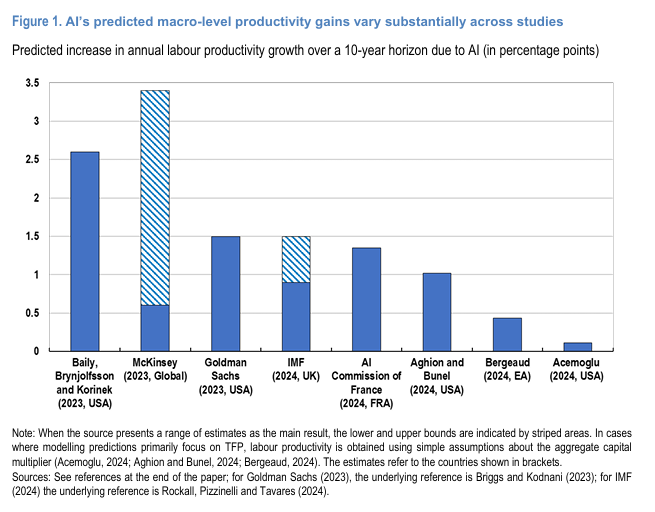
WPの図1では以下のようにAIの生産性利得の各推計をまとめている。
以下は今回の研究の概念図。

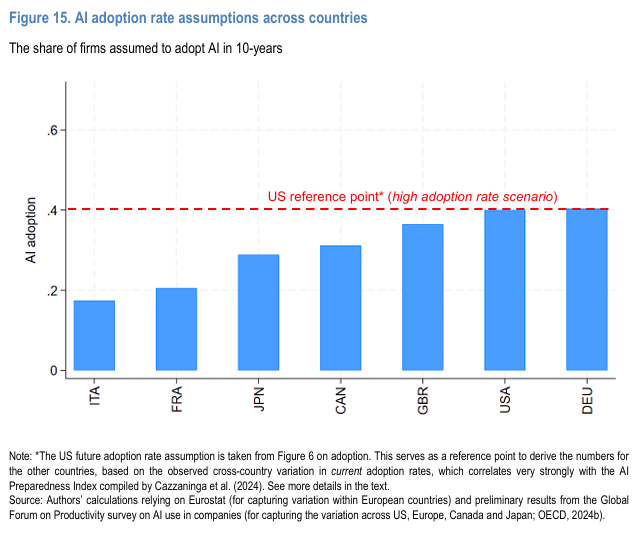
以下は今後10年のAI導入率の国別予測。日本は仏伊よりは高いが独米英加よりは低い。
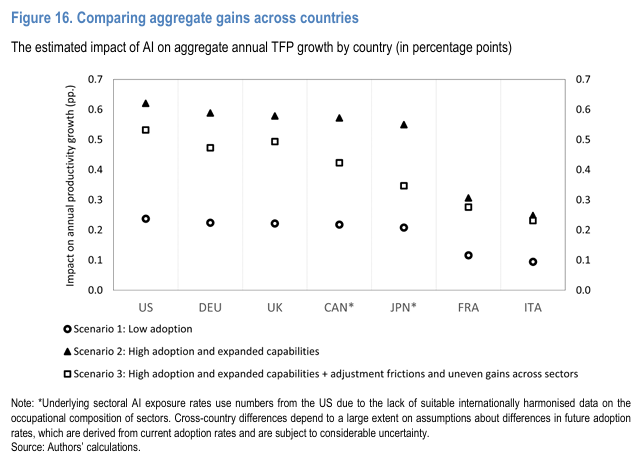
以下は総生産性利得の国別予測。高導入率シナリオでは日本も独米英加に比較的近い利得となるが、調整摩擦と部門別不均一性を考慮した場合の低下幅は最も大きい。
*1:cf. 人工知能が生産とインフレに及ぼす影響 - himaginary’s diary、掲載版はsimple macroeconomics of AI* | Economic Policy | Oxford Academic。
*2:WPでは「As some sectors experience higher productivity growth than others, both historical experience as well as the model in this paper suggest that labour will tend to reallocate from the high- to the low-growth sector (historically, from manufacturing to services) and that the low-growth sector grows as a share of GDP (Nordhaus, 2008).」と説明している(Nordhaus, 2008はBaumol's Diseases: A Macroeconomic Perspective)。
*3:cf. ミクロ経済ショックのマクロ経済への影響:ハルテンの定理を超えて - himaginary’s diary、掲載版はThe Macroeconomic Impact of Microeconomic Shocks: Beyond Hulten's Theorem | The Econometric Society。
