というNBER論文をサエズらが上げている(ungated版)。原題は「Global Working Hours」で、著者はAmory Gethin(世銀)、Emmanuel Saez(UCバークレー)。
以下はその要旨。
This paper uses labor force surveys from 160 countries to build a new microdatabase on hours worked covering 97% of the world population in cross section. We also construct time series spanning over 20 years in 86 countries. Hours worked per adult are slightly bell-shaped with GDP per capita but weakly correlated with development overall. Hours worked by the young (aged 15-19) and elderly (aged 60+) decline with development, driven by growing school attendance and public pension coverage. Hours worked among prime-age adults (aged 20-59) are mildly bell-shaped with development for men while they are increasing for women. The fall in male hours in middle-to-higher income countries is driven by reduced hours per worker and is offset by increases in female labor force participation. These two forces have exactly compensated each other in many countries, leading to a remarkable long-run stability of prime-age hours worked. Labor taxes are strongly negatively correlated with prime-age hours worked both in international comparisons and overtime within countries. Controlling for government transfers only partly reduces the link between labor taxes and prime-age hours, ruling out substitution and income effects on labor supply as the only driver. Controlling for working hours regulations and the size of the formal sector eliminates this link, suggesting that regulations also play a large role in reducing intensive hours in higher-income countries.
(拙訳)
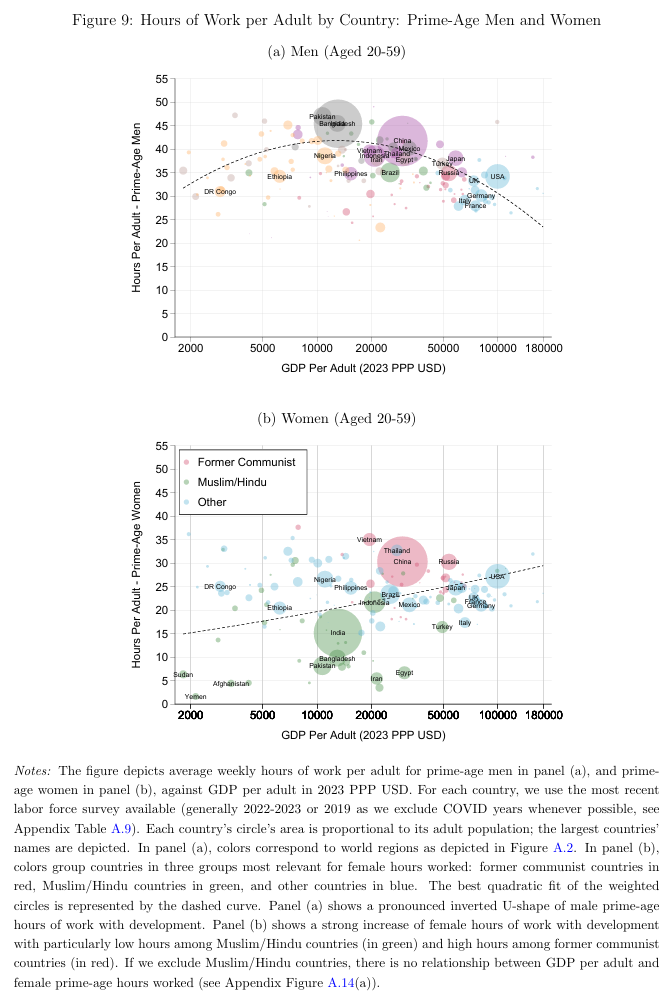
本稿は160か国の労働力調査を用いて、横断面で世界人口の97%をカバーする、労働時間の新たなミクロデータベースを構築した。我々はまた、86か国の20年以上に亘る時系列も構築した。成人一人当たりの労働時間は一人当たりGDPについて少し釣鐘状になっているが、全体的には発展と弱い相関がある。若年層(15-19歳)と高齢層(60歳以上)の労働時間は、就学と公的年金の伸びが要因となって、発展と共に低下する。働き盛りの成人(20-59歳)の労働時間は、男性については発展と共にやや釣鐘状となっているが、女性については増加する。中所得から高所得の国での男性の労働時間の低下は、労働者一人当たりの労働時間の減少が要因となっており、女性の労働参加率の増加によって相殺されている。この2つの要因は多くの国でお互いを正確に埋め合わせており、働き盛りの労働時間の驚くべき長期的な安定をもたらしている。労働税は、国際的な比較においても、国内の時系列においても、働き盛りの労働時間と強い負の相関がある。政府の所得移転をコントロールしても労働税と働き盛りの労働時間の関係は部分的にしか解消せず、労働供給への代替効果と所得効果だけが要因になっている可能性を排除する。労働時間の規制と正式な雇用部門の規模をコントロールするとその関係は解消され、高所得国における規制も内延的な労働時間を減らす上で大きな役割を演じていることを示している。
以下は男女別の発展段階と労働時間の関係を示した図。
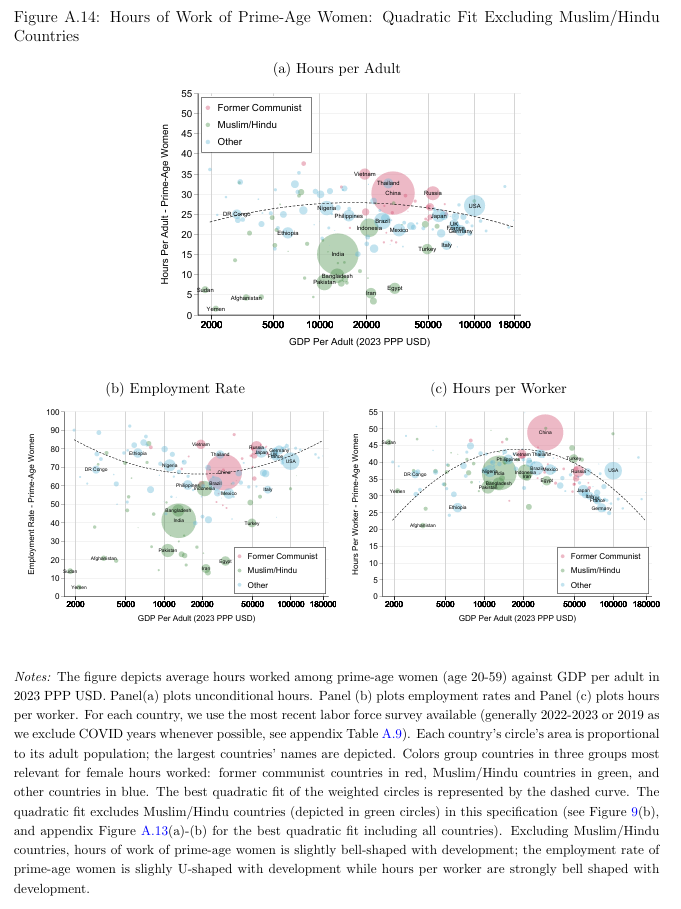
この図の注釈にあるように、ヒンドゥーとイスラムの国を除くと、働き盛りの女性の労働時間と一人当たりGDPの関係は以下のように変わってくる。