以下の内容はhttps://himaginary.hatenablog.com/より取得しました。


港から物価へ:世界供給網混乱のインフレ効果

というIMF論文をタイムリーな論文としてMostly Economicsが紹介している。原題は「From Ports to Prices: The Inflationary Effects of Global Supply Chain Disruptions」で、著者はYang Jiao(シンガポールマネージメント大)、Ting Lan(IMF)、Yang Liu(同)、Xinrui Zhao(ミシガン大)。
以下はその要旨。

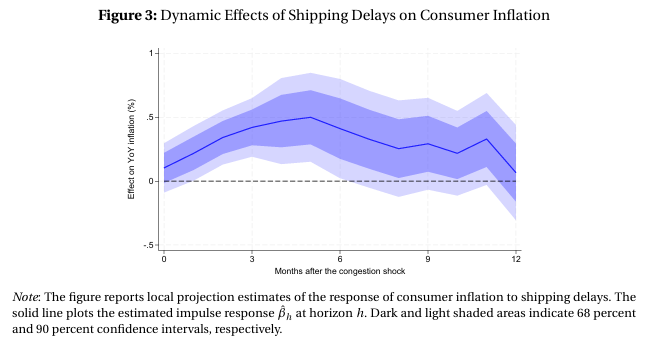
This paper examines the inflationary effects of shipping delays. We construct a novel measure of port-to-port shipping time using real-time AIS maritime data and link it with granular port-level trade and item-level price data. We document substantial heterogeneity in goods imports across ports and regions, variation in exposure to delays, and aggregate price responses to congestion shocks. Exploiting cross-product variations in exposure, we estimate both the average and dynamic effects of shipping delays on consumer prices, finding that a 100-hour delay raises inflation by roughly 0.5 percentage points at its five-month peak.
(拙訳)
本稿は、船舶輸送の遅延のインフレ効果を調べた。我々は、リアルタイムAIS海運データを用いて港から港への輸送時間の新たな指標を構築し、それを港レベルの貿易と品目レベルの価格の詳細データと結び付けた。港と地域による財の輸入の顕著な不均一性、遅延の影響のばらつき、渋滞ショックへの総体的な価格の反応を我々は明らかにした。我々は、商品による影響の違いを利用して、輸送遅延が消費者物価に与える平均的および動学的な影響を推計し、100時間の遅延がインフレを5か月後のピークにおいて約0.5%ポイント押し上げることを見い出した。

以下は遅延のCPIへの動学的効果を示した論文の図。

在宅勤務と出生率

というNBER論文が上がっているungated版)。原題は「Work from Home and Fertility」で、著者はSteven J. Davis(スタンフォード大)、Cevat Giray Aksoy(欧州復興開発銀)、Jose Maria Barrero(メキシコ自治工科大)、Nicholas Bloom,(スタンフォード大)、Katelyn Cranney(同)、Mathias Dolls(IFO研究所)、Pablo Zarate(プリンストン大)。
以下はその要旨。

We investigate how fertility relates to work from home (WFH) in the post-pandemic era, drawing on original data from our Global Survey of Working Arrangements and U.S. Survey of Working Arrangements and Attitudes. Realized fertility from 2023 to 2025 and future planned fertility are higher among adults who WFH at least one day a week and, for couples, higher yet when both partners do so. Estimated lifetime fertility is greater by 0.32 children per woman when both partners WFH one or more days per week as compared to the case where neither does. The implications for national fertility rates differ across countries due mainly to large differences in WFH rates. In a complementary analysis using other U.S. data before and after the pandemic, one-year fertility rates rise with WFH opportunities in one's own occupation and, for couples, in the partner's occupation.
(拙訳)
我々は、我々の世界労働環境調査と米国労働環境・態度調査*1の独自データを用いて、コロナ禍後の時期において出生率が在宅勤務とどのように関連しているかを調べた。2023年から2025年までの実際の出生率と今後計画している出生率は、最低週1日在宅勤務している成人において高く、カップルについては両者がそうしている場合にはさらに高かった。パートナーが両方とも週1日以上在宅勤務している場合、どちらもしていない場合に比べ、生涯出生児数の推計値は女性一人につき0.32人多くなる。国全体の出生率にとっての意味合いは国によって異なるが、それは各国の在宅勤務率が大きく違うことが主因である。コロナ禍前後の他の米国データを用いた補完的な分析では、1年の出生率は自身の職における在宅勤務の機会と共に上昇し、カップルにおいてはパートナーの職における在宅勤務の機会と共に上昇した。

Bloomらの在宅勤務に関する一連の研究(cf. 家での買い物 - himaginary’s diary)の最新版ということになる。国際比較研究ということで、著者は在宅勤務時の節約時間 - himaginary’s diaryなぜ在宅勤務は国と人によって違うのか? - himaginary’s diaryで紹介した研究とほぼ同様の顔触れとなっている。

ちなみに在宅勤務と出生率の関係ということでは先行研究としてコロナによる出生の増加:コロナ禍に対応した予期せぬ米国の出生率の増加 - himaginary’s diaryで紹介した論文があるが、本論文でも参照されている。また、関連研究として在宅勤務の増加は労働市場における母であることのペナルティを減らしたか? - himaginary’s diaryで紹介した論文もあるが、これも本論文でも参照されている。

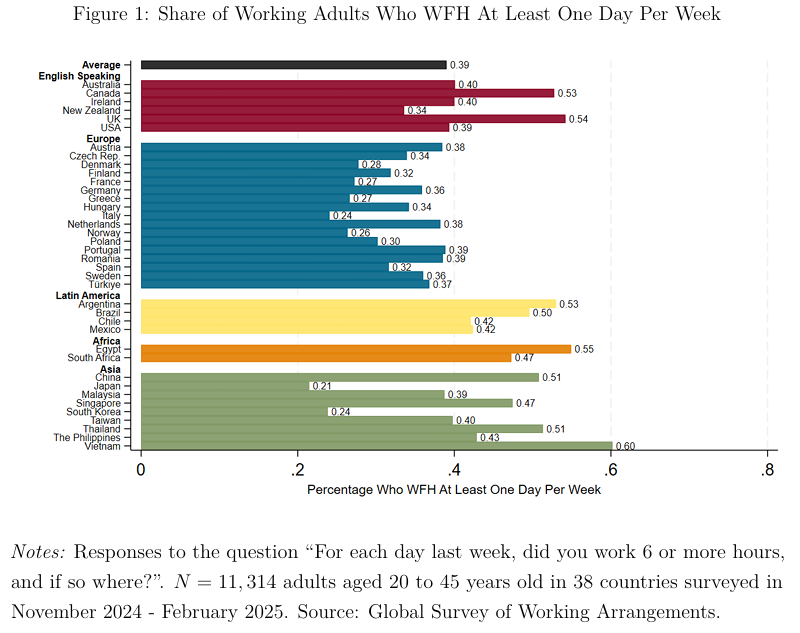
以下は論文の図1。日本の20-45歳の週1日以上の在宅勤務率は0.21と調査対象国中最低となっており、最高はベトナムの0.6である。

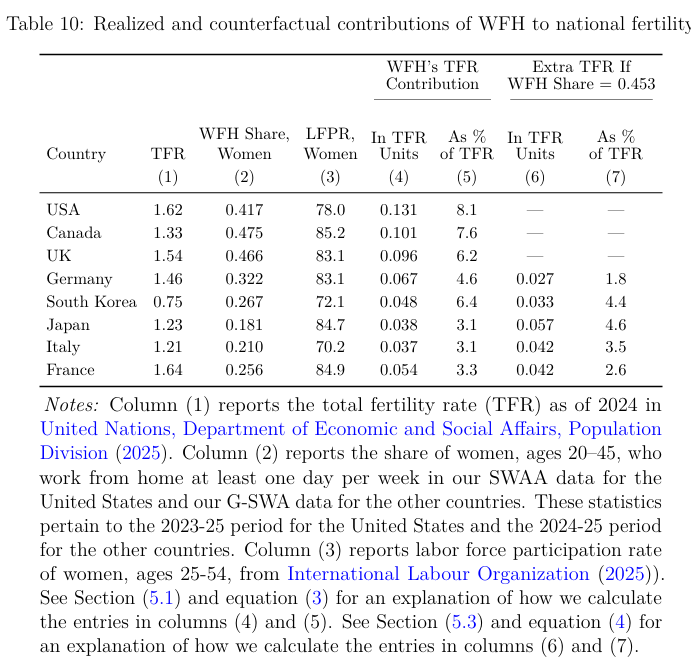
このため、推計された生涯出生児数への在宅勤務の寄与は、日本は0.038とイタリアの0.037と並んで低く、カナダの0.101や米国の0.131に水をあけられている。 合計特殊出生率への寄与率では、日伊は3.1%なのに対し、カナダは7.6%、米国は8.1%になるという。そのことを論文では以下の式で推計している。
 WFH Contribution to TFRc = βc[WFHshc ×LFPRc]  (3)
日本の女性の労働参加率LFPRcは84.7%、女性の在宅勤務率WFHshcは0.181で、係数βcとして論文は0.249を用いている。そのため、在宅勤務の合計特殊出生率TFRへの寄与は0.038となる。日本のTFRは1.23なので、率にして3.1%である。

逆に言えば、在宅勤務率を標準値(ここでは女性の米英加平均の0.453としている)まで引き上げれば、出生率を上げることができる。そのことを論文では以下の式で示している。
 (Extra Fertility)c = βc[(0.453 − WFHshc) × LFPRc],  (4)
この式に上述の値を当てはめると、出生率の引き上げ効果は0.057、率にして4.6%と見込まれる。日本の2024年の出生数686,061 人にこの率を掛けると約31,800人になる、と論文は述べている。

以下は、代表的な国について上記の計算を行った表10。

Olivetti and Petrongolo(2017)の研究*2によると、先進国の早期児童養護・教育への政府のGDP1%分の追加的な支出は出生率を0.2引き上げるという。米国の支出は0.4%なので、引き上げ効果は0.08 に留まり、この表の在宅勤務の効果0.13よりかなり小さくなる、と論文では指摘している。他の国では在宅勤務率がもっと低く、また支出がもっと多いかもしれないので、結果は違ってくるだろう、とも論文では指摘している。

ベトナム戦争とイラン戦争

をブランシャールが比較している。

A striking analogy:
Vietnam: a war of choice, major US military domination, guerilla war. We know the outcome.
Iran: a war of choice, major US military domination, guerilla war, but this time on a global scale. Outcome?
(拙訳)
驚くべき類似:
ベトナム:敢えて踏み切った戦争、米軍が軍事的に大いに優位に立った、ゲリラ戦争。その結果を我々は知っている。
イラン:敢えて踏み切った戦争、米軍が軍事的に大いに優位に立った、ゲリラ戦争、ただし今回は世界的規模で。その結果は?

https://x.com/ojblanchard1/status/2033105699589284226

これにジョン・コクランが反応し、

I would be curious to hear Olivier's analysis of the effects of inaction. Ignore Oct 7, leave Iran to build missiles, terror networks, and a nuclear bomb to use on you-know-who. More negotiations? More stern statements? The example is overused, but 1939: inaction of choice. We know the outcome.
(拙訳)
不作為の効果についてオリビエの分析を是非聞きたい。10月7日を無視し、イランのミサイル組み立て、テロのネットワーク、標的が明らかな核爆弾を放置する。もっと交渉? もっと厳しい声明? 使い古された事例ではあるが、1939年:敢えて何もしなかった。その結果を我々は知っている。

https://x.com/JohnHCochrane/status/2033195762482663527

と問い掛けた。

このコクランのツイートに、ブランシャールが著名な経済学者でなければ誰も反応しないだろう、このコメントは馬鹿げているのだから、というレスが付いたが、それに対しコクランは

That's not true. US foreign policy has a longer list of disasters. Afghanistan, Iraq, Lybia, Syria, Ukraine. Why is this different is a question even economists should ask, as the "experts" aren't doing so well. I tentatively think he's wrong, but really smart + never "inane."
(拙訳)
それは違う。米外交政策には惨事の長い一覧表がある。アフガニスタン、イラク、リビア、シリア、ウクライナ。「専門家」の成績があまり芳しくない以上、今回が違うというのはなぜか、というのは経済学者でさえ尋ねるべき問いである。今のところ私は、彼は間違っていると思うが、非常に賢く、決して「馬鹿げて」はいない。

https://x.com/JohnHCochrane/status/2033199266760692022

と応じている。


ブランシャールはまた、トランプの発言を以下のように皮肉っている。

For once I fully agree with Trump 😀:
"We have already destroyed 100% of Iran’s Military capability, but it’s easy for them to send a drone or two, drop a mine, or deliver a close range missile somewhere along, or in, this Waterway, no matter how badly defeated they are.”
I would not have said it better myself (except maybe for the 100% part). It might have been a good idea to think about it (and take it into account) two weeks ago.
(拙訳)
これについてはトランプに完全同意。
「我々は既にイランの軍事能力を100%破壊したが、彼らはどれほど手酷く敗けていても、彼らは容易くこの海峡沿いもしくは海峡の中のどこかに、1機か2機のドローンを送ったり、機雷を落としたり、近距離ミサイルを打ったりすることができる。」
(おそらく100%の箇所を除けば)これ以上上手い表現を私は思いつかない。2週間前にそのことについて考えを巡らせて(かつ考慮に入れて)いたら良かったのに、というところである。

https://x.com/ojblanchard1/status/2033508793284280485

2021-24年のインフレ急騰に財政赤字はどの程度寄与したのか?

についてリカルド・ライス(Ricardo Reis)がツイートしている

How much did public deficits contribute to the inflation surge of 2021-24?
A popular argument notes that inflation rose in the US by almost as much as in other OECD countries. Yet, the US had a large fiscal stimulus in 2021 that most other countries did not. Therefore, the US fiscal stimulus did not contribute to the inflation surge. Is that right? No, it is not.
To inspect this claim, you can use expectations data. By virtue of its mandate, the IMF is one of the best forecasters of fiscal variables and all economists pay attention to them. The IMF also forecasts inflation; during 2021-24, it was as right or as wrong as other institutions or surveys.
Start from the IMF's forecasts in October of 2019 for the next 5 years of how much public debt would grow and what would be fiscal deficits, interest rates, inflation, and growth rates. Then look at the IMF April 2025 reports of those actual variables. Subtract one from the other and you have how much of the unexpected increase in public debt was due to unexpectedly high deficits, unexpectedly high interest rates, unexpectedly low growth rates and unexpectedly high inflation.
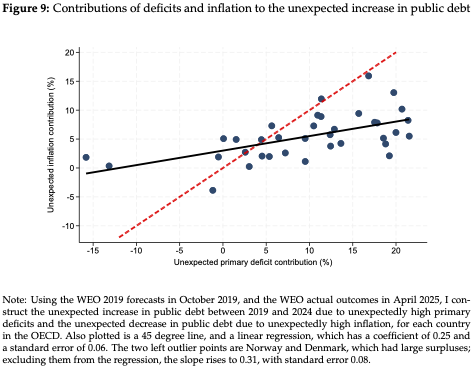
The plot compares the unexpected high deficits with the unexpected high inflation terms for OECD countries, using the common units of their impact on the public debt.
For countries that ran higher unexpected fiscal deficits, inflation was also unexpectedly higher.
Some countries had their stimulus early, others only later. Somer larger, other smaller. Some had more, others less inflation. The accounts of the government let you consistently sum these differences over the 5 years to look beyond timings and to use consistent units. Thinking in terms of surprises and using expectations data allows you to compare countries with very different fiscal trajectories.
More generally, in all models and theories of inflation, including fiscal account, expectations are crucial. Using expectations data to inspect them is very informative.
Note: as with the initial claim, the plot is a correlation, not a causal statement.
Sources:
(i) Section 4 in Reis "Why Did Inflation Rise and Fall in 2021-24? Channels and Evidence from Expectations"
(ii) This simple exercise is inspired on the analysis of Barro and Bianchi “Fiscal Influences on Inflation in OECD Countries, 2020-23.”
(拙訳)
2021-24年のインフレ急騰に財政赤字はどの程度寄与したのか?
一般的な議論では、米国のインフレ上昇は他のOECD諸国とほぼ同程度だった、と言われている*1。しかし、米国は2021年に他の大半の国が実施しなかった大規模な財政刺激策を実施した。従って、米国の財政刺激策はインフレ高騰に寄与しなかった。これは正しいか? いいや、正しくない。
この主張を検査するために予想データを使うことができる。IMFは、その職務の性格上、財政変数の最良の予測者の一つであり、全ての経済学者はそれに注意を払う。IMFはインフレも予測する。2021-24年において、そのインフレ予測の当たり外れは他の機関や調査と同程度であった。
まず、2019年10月のIMF予測で、今後5年間に公的債務がどれだけ増加し、財政赤字、金利、インフレ、成長率がどうなるか、についての予測を見てみよう。次いでIMFの2025年4月の報告書で、それらの変数の実際の値を見てみよう。後者から前者を差し引けば、予期せぬ公的債務の増加がどの程度、予期せぬ大きな財政赤字、予期せぬ高金利、予期せぬ低成長、および予期せぬ高インフレのせいだったかが分かる。
下図では、OECD諸国について、公的債務への影響について単位を共通化して、予期せぬ大きな財政赤字を予期せぬ高インフレと比較している。
予期せぬ大きな赤字を計上した国は、インフレも予期せずして高くなる。
ある国は刺激策を早期に実施し、他の国は遅れて実施した。ある国は大規模に、他の国は小規模に実施した。ある国のインフレは高く、他の国のインフレはそれほど高くならなかった。政府会計から、タイミングに捉われず、かつ一貫した単位を用いて、5年間のそうした差を整合的な形で合計することができる。サプライズという観点で捉え、予想データを使うことで、かなり異なる財政経路を辿った国を比較することができるのである。
より一般的な話として、政府会計を含むすべてのインフレのモデルと理論において、予想は極めて重要である。予想データを使ってそれらを調べることは、情報面で非常に実り多いものである。
注:当初の主張におけるのと同様、図は相関であり、因果関係に関する記述ではない。
ソース:
(i) ライス「2021-24年になぜインフレは上昇し低下したのか? 予想の経路と実証結果*2」の4節
(ii) この簡単な演習はバローとビアンキの「2020-2022年のOECD諸国におけるインフレへの財政の影響*3」の分析に触発されたものである

これにブランシャールが反応し、以下のように問い掛けている

did you take into account that, in many countries, some of the increase in the primary deficit came from measures (price caps, subsidies) aimed at limiting inflation (something that would go the other way)? (I did not see anything about this in the underlying paper)
(拙訳)
多くの国では、基礎的財政赤字の増加の一部はインフレを抑えることを目的とした政策(価格上限規制、補助金)から生じていることを考慮に入れたかな?(両者は相反する方向に動く) (元の論文でそれに関する記述を全く見つけられなかった)

ライスの回答は以下の通り

It is an unconditional correlation. Conditional on your effect, it would be negative, so other forces must have quantitatively been stronger to make it positive overall.
(拙訳)
これは無条件相関だ。貴兄の言う効果についての条件付きの相関はマイナスになるはずだ。従って全体の相関をプラスにするために、他の力は定量的にもっと強いはず、ということになる。

シムズの功績

についてブランシャールがツイートしている。

RIP Chris Sims.
I was enormously influenced by Chris. My own, perhaps idiosyncratic take:
His main contribution came at a time when macroeconomists had constructed the first wave of big macroeconometric models. They were constructed piece by piece, a consumption block, an investment block, and so on. Each piece looked reasonable, but when assembled together, the implied macro dynamics were all wrong.
What Chris did was to turn things around, namely argue that one had to start from the actual macro dynamics, the so called VARs, and show how, with minimal identification conditions (leading to "structural" VARs), they could be used to suggest the dynamic effects of various shocks, dynamics that the structural models had to replicate.
To say that his approach was influential would be to understate its influence. Today, a model that did not fit the VAR evidence, would be simply dismissed.
(拙訳)
クリス・シムズ、安らかにお眠り下さい。
私はクリスから大きな影響を受けました。私自身の、おそらくは私固有の受け止めは以下の通り。
彼の主たる貢献は、マクロ経済学者が大型マクロ計量経済モデルの第一波を構築した時に行われた。そうしたモデルは部門別に構築された。消費部門、投資部門、等々、である。各部門は理に適っているように見えたが、組み合わせると、そこから導かれるマクロ動学は全く間違っていた。
クリスがやったのは話を逆にすることだった。即ち彼は、実際のマクロの動学から出発しなければならない、と主張した。それがVARsと呼ばれるものであり、最小限の識別条件(それが「構造」VARにつながった)でそれが様々なショックの動学的効果、構造モデルが復元すべき動学を示すのに使えることを示した。
彼の手法は影響力があった、と言うのはその影響を過小評価することになろう。今日では、VARの実証結果に適合しないモデルは単に退けられる。

https://x.com/ojblanchard1/status/2033110578797949076

ちなみにシムズの訃報はタイラー・コーエンがMarkus K. Brunnermeierのツイートを引く形で亡くなった日の午後3:16(東部時間)に報告している。以下はBrunnermeierのツイート。

R.I.P. Christopher Sims (21 Oct. 1942 - 14 March 2026)
- a giant in macroeconomics and one of the finest human beings I have ever met -
(拙訳)
クリストファー・シムズ、安らかにお眠り下さい(1942年10月21日ー2026年3月14日)
~マクロ経済学における巨人であり、私が出会った中で最も素晴らしい人間の一人~

https://x.com/MarkusEconomist/status/2032897564220010515

中銀の独立性毀損のマクロ経済的帰結:総裁交代の実証結果

というIMF論文をMostly Economicsが紹介している。原題は「The Macroeconomic Consequences of Undermining Central Bank Independence: Evidence from Governor Transitions」で、著者はMarijn A. Bolhuis(IMF)、Rui Mano(同)、Hedda Thorell(ストックホルム大)。
以下はその要旨。

This paper studies the macroeconomic consequences of undermining central bank independence through politically motivated transitions of central bank governors. Leveraging a new panel dataset covering 132 central bank governor transitions in 28 advanced and emerging market economies since 2000, we document the timing, frequency, and political drivers of these leadership changes. Tenures of governors with politically motivated appointments are associated with higher and more volatile inflation, realized and expected. Professional forecasters also tend to expect such governors to be more dovish when responding to shifts in inflation. Using local projections in a difference-in-difference setting, we find that following the announcement of a politically motivated governor transition nominal and real short rates decline and expected and realized inflation rise. At the same time, GDP growth increases in the aftermath of such transitions, consistent with an expansionary short-run macroeconomic impulse. These effects are more pronounced when the incoming governor professes unorthodox views on monetary policy, suggesting that political interference in central bank leadership induces a temporary growth–inflation trade-off. Long-term inflation expectations only rise in the case of unorthodox governors with politically motivated appointments, suggesting costs to central bank credibility are much more pronounced in those cases.
(拙訳)
本稿は、政治的動機による中銀総裁の交代を通じて中銀の独立性を弱めることのマクロ経済的な帰結を調べた。2000年以降の28の先進国と新興国における132の中銀総裁の交代をカバーした新たなパネルデータセットを用いて我々は、そうしたトップの入れ替えのタイミング、頻度、および政治的要因を明らかにした。政治的動機で指名された総裁の在任期間において、実際のインフレおよび予想インフレはより高く変動的だった。予測専門家もまた、そうした総裁はインフレの変化への対応においてよりハト派的である、と予想する傾向にあった。差の差の枠組みでローカル予測を用いて我々は、政治的な動機に基づく総裁交代の発表の後、名目と実質の短期金利が低下し、予想および実際のインフレが上昇することを見い出した。同時に、そうした交代の後にGDP成長率は高まるが、これは短期の拡張的なマクロ経済刺激と整合的である。以上の効果は、着任する総裁が金融政策について非伝統的な見解を明言している場合はより明確で、中銀のトップへの政治的介入が一時的な成長とインフレのトレードオフを引き起こすことを示している。長期のインフレ予想が高まるのは政治的動機で指名された非伝統的な総裁の場合だけであり、そうした場合に中銀の信認へのコストがより明確になることを示している。

ホルムズ海峡封鎖が意味すること

についてブランシャールが活発にツイートしている。

getting slightly out of my lane.
fascinating how the security of a 4 miles wide piece of sea determines whether the conflict is limited to the middle east, or whether it affects all the countries in the world.
fascinating how drone technology and low cost is such that it seems nearly impossible to protect the strait, no matter the cost.
fascinating how the implications of this choke point have been known for decades and Kuwait has not built an oil pipeline to get the gas to the red sea. Yes, the cost was high. But higher than the cost to the world of what is happening today?
(拙訳)
少し専門外の話をする。
4マイル幅の海の片隅の安全保障が、紛争が中東に留まるか、それとも世界の全ての国に影響するかどうかを左右する、というのは実に面白い。
ドローン技術とその低コストにより、どれだけコストを掛けても海峡の防御がほぼ不可能になる、というのは実に面白い。
この隘路の意味することは何十年にも亘って知られていながら、クウェートがガスを紅海に搬出するための石油パイプラインを建設していなかった、というのは実に面白い。確かに建設コストは高額だ。しかし今日起きていることが世界に課すコストよりも高いのか?

https://x.com/ojblanchard1/status/2031462126175310146

このツイートへのレスには、ガスではなく石油だろう、という突っ込みや、往復それぞれ2マイルに両航路の距離を加えて実際には6マイルだ、という指摘が入っているほか、クウェートが全世界のためにコスト負担をするのは合理的ではない、という当然予想される指摘が幾つか入っている(中には、パイプラインもドローンに脆弱ではないか、という指摘や、コース的な解決を考えているのか、という指摘もある)。

In war, there are, to borrow from Rumsfeld, unknown unknowns. These are hard to prepare for. But at least, one should prepare for known knowns… And the closing of the strait of Hormuz is at the top of that list. (In the early 2010s, when I was at the IMF, we looked at a scenario precisely along these lines)
(拙訳)
戦争では、ラムズフェルドの言葉を借りれば、未知の未知がある。それらは備えることが難しい。しかし少なくとも、既知の既知には備えておくべきである。そしてホルムズ海峡封鎖はそのリストの先頭に来る(2010年代初めに私がIMFにいた時、まさにそうしたシナリオを検討した)。

https://x.com/ojblanchard1/status/2032060945137058263

このツイートに、ホルムズ海峡を相当程度代替できるパイプラインが既に存在することは考慮したのか、という指摘が入ったのに対し、ブランシャールは次のように応じている。

yes. Kuwait does not have a pipeline. Saudi Arabia has a very limited capacity pipeline. Same for UEA. Taken into account in the estimate I give.
(拙訳)
考慮済みだ。クウェートはパイプラインを持っていない。サウジアラビアは極めて限られた容量のパイプラインを持っている。UAE*1も同じだ。私の推計ではそれらは考慮した。

https://x.com/ojblanchard1/status/2032081030035755209


次いで、価格上昇シナリオについてツイートしている。

I find it hard not to have as a central scenario where oil prices will remain very high for a long time, higher than the market current prices.
I am no expert on geo-politics and defense technology, but this is what I think I have learned:
Fully protecting ships in the strait of Hormuz is basically impossible. Not enough time to stop missiles or drones.
There is no reason, whether or not Trump declares that war is over, to think that Iran will not continue for some time to threaten to destroy the ships that try. Why should they stop?
The risk will thus remain sufficiently high that most non Iranian ships will not take the risk.
Thus, the shortfall of 20 million barrels a day is likely to last for long.
The scope for increased supply from elsewhere is very limited in the short run. Perhaps 2 million barrels at the most.
The 400 million barrels reserve release can only add 3-4 million barrels or so daily.
The short run elasticity of demand for oil is very low, at most -0.1, and probably less.
This suggests to me prices closer to 150-200 dollars per barrel (or more, but I hesitate to give higher numbers…) than to the current market price.
To repeat. I am no expert (As an economist, I have a bit more sense about the next step, namely what such a price would to the world economy). I would be more than happy to be proven wrong.
(拙訳)
原油価格が現在の市場価格よりも長期に亘って大きく高止まりするメインシナリオを考えないのはあり得ないことだと思う。
私は地政学と防衛技術については専門家ではないが、以下のことを学んだと考えている。
ホルムズ海峡で船舶を完全に護衛するのは基本的に不可能だ。ミサイルやドローンを打ち落とすだけの時間の余裕がない。
トランプが戦争終結宣言を出すか否かにかかわらず、イランがしばらくの間、通行を試みる船舶を破壊するという脅しを続けないと考える理由はない。彼らにそれを止める理由があるだろうか?
従って、イラン以外の船舶の大半がそのリスクを取らない、という危険性はかなり高いままとなろう。
従って、日量2000万バレルの不足は長く続く可能性が高い。
余所からの供給増の余地は短期的には極めて限られる。おそらく200万バレルがせいぜいだろう。
4億バレルの備蓄の放出は日量300-400万バレル程度を追加するに過ぎない。
短期的な原油の需要の弾力性は極めて小さく、せいぜい-0.1で、おそらくそれよりも小さい。
これからすると、現在の市場価格ではなく1バレル150-200ドルに近い価格が然るべき価格のように私には思われる(もしくはそれ以上だが、もっと高い数字を出すのは躊躇われる・・・)
繰り返しになるが、私は専門家ではない(経済学者として、次の段階、即ちそうした高価格が世界経済に持つ意味についてはそれよりは少し分かっている)。私が間違っていることが分かればそれに越したことは無い。

https://x.com/ojblanchard1/status/2032053039566070081

In the set of assumptions, the crucial one is whether Iran will commit to not hit ships in the strait. The issue is that Iran does not need to actually do anything, just to leave some ambiguity as to whether it might do it. And I think it is in their interest to do so. To suggest deals: letting the ships from country x go through in exchange for some form of help, etc. (in that respect, mines is different from drones.)
(拙訳)
一連の仮定の中で極めて重要なのは、イランが海峡で船舶を攻撃しないと約束するかどうかだ。問題なのは、イランは実際には何もする必要はなく、攻撃するかどうかについて幾ばくかの曖昧さを残すだけで良い、ということだ。それが彼らの利益に適うのだと私は思う。取引を持ち掛けるのであれば、何らかの形の援助と引き換えにx国の船舶の通行を認める、といった形になろう(その意味で機雷はドローンと話が違ってくる)。

https://x.com/ojblanchard1/status/2032104062720635303

Market participants (who are more knowledgeable than I about this particular market) must disagree with one of the assumptions. I do not know which one. I suspect it is that they believe there will be a cease fire and Iran will open the strait, end of story. Maybe...
(拙訳)
(この特定の市場について私よりも良く知っている)市場参加者は仮定の一つに同意しないに違いないが、どの仮定かは私には分からない。停戦が成立してイランが海峡を開放する、以上、となると彼らは考えているのではないかと私は思う。あるいはそうなるかもしれない・・・。

https://x.com/ojblanchard1/status/2032109107402948891

As always, I have learned from the comments. X as crowd sourcing. Arguments go both ways.
The Aramco announcement that they can increase flow through pipeline to the red sea up to 7 mbds (whereas the assumption earlier was for a smaller feasible increase). But loading capacity at Yanbu terminal appears to be less, perhaps 3- 5 mbds, so only 2-3 more than it did pre-war.
The decision by the US to wave oil-related sanctions on Russia. (not good news for Ukraine) . Probably small effect.
Uncertainty about the short run demand elasticity: closer to -0.1 or to -0.05 ? Compared to my assumption of -0.1, this doubles the effect on the price of any supply decrease.
As storage facilities fill up in the Persian Gulf, need to close production or extraction facilities, which takes longer to undo.
A tougher line by Iran on the strait of Hormuz. Higher likelihood of mines.
Bottom line. I stick to a high probability of higher for longer, higher than current and forward prices suggest.
Still, eager to learn more.
(拙訳)
いつものように、コメントから多くを学んだ。クラウドソーシングとしてのXだ。議論は双方向ということだ。
紅海へのパイプラインの流量を日量700万バレルまで増やせる、という声明をアラムコが出した*2(先の仮定では実現可能な増分をもっと低く見積もっていた)。しかしヤンブー港での積載能力はそれよりも低いと思われ、おそらく日量300-500万バレルだろう。従って戦争前よりも200-300万バレル増えるに過ぎない。
ロシアへの原油関連の制裁を解除する*3、と米国が決定した(ウクライナにとっては良いニュースではない)。おそらく効果は小さい。
短期の需要の弾力性の不確実性について。-0.1に近いのか、それとも-0.05に近いのか? -0.1という私の仮定と比べると、-0.05は、何らかの供給減の価格への影響を倍増させる。
ペルシャ湾での貯蔵設備が満杯になると、生産や抽出の設備を操業停止する必要があり、復旧時には停止よりも時間が掛かる。
ホルムズ海峡についてイランがより強硬な路線を取ったり、機雷敷設の可能性がもっと高かったりするかもしれない。
基本的には、現物および先物の価格が示唆するよりも高い価格で、より長くより高価格となる可能性が高い、というシナリオを私は固持する。
とは言え、より多くを学びたいと考えている。

https://x.com/ojblanchard1/status/2032408627345027536

Could it be that the focus on energy efficiency and the resulting decrease in the share of oil has actually decreased the short run elasticity of demand? If so an interesting example of the trade off between efficiency and resilience.
(拙訳)
エネルギー効率への注力とその結果としての原油シェアの低下は、短期的な需要の弾力性を実際に低下させたという可能性はあるのか? もしそうならば、これは効率性と弾力性との間のトレードオフの興味深い事例になるだろう。

https://x.com/ojblanchard1/status/2032432838969061576

この後ブランシャールは、短期的な価格弾力性の有意な低下を実際に観測し、エネルギー効率性の上昇をその理由として論じた論文を書いた、というゲント大のGert PeersmanのツイートをRTしている。
*1:ブランシャールはUEAと書いているのでフランス語の記法かと思ったが、Émirats arabes unis — WikipédiaによるとそれはEAUなのでただの誤記のようである。

*2:cf. サウジ、紅海経由の3月原油輸出が過去最高に ホルムズ補完には不十分 | ロイター

*3:waveは多分waiveの誤記。


以上の内容はhttps://himaginary.hatenablog.com/より取得しました。
このページはhttp://font.textar.tv/のウェブフォントを使用してます

不具合報告/要望等はこちらへお願いします。
モバイルやる夫Viewer Ver0.14