

小判状との出会い
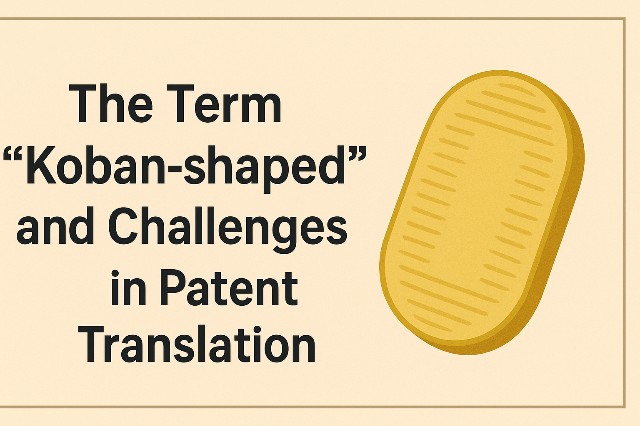
他社の公開特許公報を読んでいて「小判状(こばんじょう)」という言葉を見つけた。私が主に扱う機械系の分野では、形状をよく知られた物に例えて表現することが多い。江戸時代に使われていた貨幣である小判は、日本人にとって馴染み深いものであり、形状の比喩として用いると理解しやすいのは確かである。
翻訳における難しさ
しかし問題は、そのような特許出願を翻訳して海外出願を行う場合である。日本人には「小判状」で通じても、他国では全く理解されない可能性が高い。海外出願の可能性を考えるならば、翻訳の便宜を考慮し、小判状という表現は避けるのが無難であろう。
代替表現の模索
では、小判状をどのように表現すればよいのか。AIとディスカッションしながら考えてみた。
幾何学的にかみ砕いて説明するならば、
「両短辺を外側に凸の曲線(あるいは外側に凸の半円)で置き換えた長方形状」
という表現が考えられる。
他のアイデアとして、AIからは「錠剤状」や「カプセル状」という案も出された。確かに分かりやすい表現であり、AIの知見に感心させられた。ただし真円状の錠剤やカプセルも存在するため、小判のような細長い形を正確に伝えるには不十分な面もある。とはいえ、小判の中にも真円形に近いものが存在したのかもしれず、あまりイチャモンをつけるのも野暮なのかもしれない。
また、「スタジアム形状」や「オブラウンド(obround)」という表現も有用である。前者は非常にわかりやすく、後者は私にとって初耳であったが、実際に使用例が多い言葉のようである。
他の日本独自の形状表現
小判状以外にも、日本語に特有で翻訳が難しい形状表現は多い。私が見聞きしたものと、その翻訳の私案をいくつか挙げておく。
- おにぎり状 → 角を丸くした三角形状
- 富士山状 → 円錐状、または円錐台状
- コの字状 → Channel(水路)状
弁理士の立場と私の考え
特許出願の原稿を作成する弁理士の中には、日本の出願を起案する際には、あくまで日本語として明確な表現を選ぶことに心を砕くべきであり、翻訳を意識するのは邪道であるとする意見もある。翻訳の工夫は翻訳者の職分であって、弁理士の責務ではないと公言する人もいる。
確かにそのようなこだわりも理解できるが、実際には日本出願の目的は日本国内の権利取得にとどまらず、海外出願の基礎とすることも含まれる。少なくとも私の考えでは、翻訳の後工程にも配慮することは、弁理士の職責の一部である。
English Translation
The Term “Koban-shaped” and Challenges in Patent Translation
Encountering the Term
While reading other companies’ published patent applications, I came across the term “koban-shaped.” In the field of mechanical engineering, which I mainly deal with, it is common to describe a shape by comparing it to something well-known. The koban, a coin used during the Edo period, is familiar to Japanese people, so using it as a metaphor for a shape is certainly easy to understand.
Difficulties in Translation
The difficulty arises when such patent applications need to be translated and filed abroad. Although “koban-shaped” makes sense to Japanese people, it is unlikely to be understood in other countries. Considering the possibility of overseas filings, it would be safer to avoid using “koban-shaped” for the sake of translation convenience.
Exploring Alternative Expressions
So how should one describe “koban-shaped”? I discussed this question with AI.
If broken down geometrically, one could describe it as:
“A rectangular shape with both short sides replaced by outwardly convex curves (or outwardly convex semicircles).”
Another idea suggested by AI was “tablet-shaped” or “capsule-shaped.” These are indeed easy-to-understand expressions, and I was impressed by the AI’s insight. However, since there are also perfectly round tablets and capsules, they may not accurately convey the elongated form of a koban. That said, there might also have been kobans that were close to a perfectly circular shape, so it may be somewhat nitpicky or inelegant to complain too much about such terminology.
In addition, I learned expressions like “stadium-shaped” and “obround.” The former is very straightforward, while the latter was new to me, but it seems to be a commonly used term.
Other Japan-specific Shape Expressions
Besides “koban-shaped,” there are many Japanese shape expressions that are difficult to translate. Here are some I have encountered, along with my proposed translations:
- Onigiri-shaped → Rounded triangular shape
- Mt. Fuji-shaped → Conical shape, or truncated cone shape
- Ko-no-ji-shaped → Channel-shaped
Patent Attorneys’ Perspectives and My View
Some patent attorneys argue that when drafting Japanese applications, one should focus solely on using precise Japanese expressions, and that considering translation convenience is misguided. They insist that translation choices are the responsibility of translators, not attorneys.
While I understand such a stance, in reality, the purpose of Japanese filings is not only to secure rights domestically but also to serve as the basis for overseas applications. At least in my view, paying attention to the later translation process is also part of a patent attorney’s professional responsibility.
Vocabulary Explanations (for Japanese readers)
- outwardly convex: 外側に凸の、外に向かってふくらんだ曲線を指す。
- semicircle: 半円。数学的な幾何用語。
- tablet-shaped: 錠剤のような形状を意味する。薬の丸薬をイメージした表現。
- capsule-shaped: カプセルのような形状を意味する。医薬品カプセルの形に由来。
- stadium-shaped: 短辺を半円にした長方形を意味する。競技場の形に由来。
- obround: 工業分野でよく使われる用語で、長円に近い形状を意味する。oval よりも「両端が丸い長方形」に近いニュアンス。
- truncated cone: 円錐台。富士山のように上が平らに切られた円錐を指す。
- channel-shaped: 水路や溝の断面に似た形を指す。建築や工学でよく用いられる表現。
- nitpicky: 揚げ足を取るように細かいことを気にする、というニュアンス。日本語の「イチャモンをつける」に近い。
- inelegant: 優雅さに欠ける、または洗練されていない、という意味。ここでは「野暮」に近いニュアンスで使用。
