I will investigate the original source and basis for the theory that "dead investors perform best".
- The "Dead Investors Perform Best" Theory
- Origins and Evidence
- Who is O'Shaughnessy?
- Still, "Dead Investors Perform Best" Works Well as an Allegory
- Research: "Frequent Trading Reduces Performance"
- Conclusion
The "Dead Investors Perform Best" Theory
A while back, a theory claiming that deceased investors had the best investment performance became a hot topic.
Since then, this claim has been referenced and debated in various places.
Let me investigate and summarize the origins and evidence behind this "dead investors perform best" theory.
Note: This article was translated from my original post.
Origins and Evidence
First, what's the source of this finding? It's commonly attributed to a conversation from Bloomberg Radio's Masters in Business podcast series, which aired in 2014.
During a conversation between James O'Shaughnessy and host Barry Ritholtz, the following exchange took place:
O'Shaughnessy: "Fidelity had done a study as to which accounts had done the best at Fidelity. And what they found was..."
Ritholtz: "They were dead."
O'Shaughnessy: "...No, that's close though! They were the accounts of people who forgot they had an account at Fidelity."
Reference: Forgetful Investors Performed Best - Business Insider
You can listen to this part of the conversation starting around 58:57 at the link below:
Masters in Business: James O'Shaughnessy - Mixcloud
As for the Fidelity study mentioned, I couldn't find any data or official research results despite extensive searching. All references to the Fidelity study trace back to this conversation as their source.
To summarize:
- The source of the "dead investors perform best" theory is O'Shaughnessy's 2014 statement
- He didn't actually say "dead investors perform best," but rather "people who forgot they had an account perform best"
- The existence of the Fidelity study itself remains unconfirmed
Who is O'Shaughnessy?
Who exactly is this O'Shaughnessy who made the statement?
According to the podcast episode description:
James O'Shaughnessy, the chief executive officer of O'Shaughnessy Asset Management.
James O'Shaughnessy, who was Chief Executive Officer of O'Shaughnessy Asset Management in 2014, is a renowned investor and published author.
O'Shaughnessy retired from O'Shaughnessy Asset Management in 2022, and currently (as of 2023) his son Patrick O'Shaughnessy serves as Chief Executive Officer.
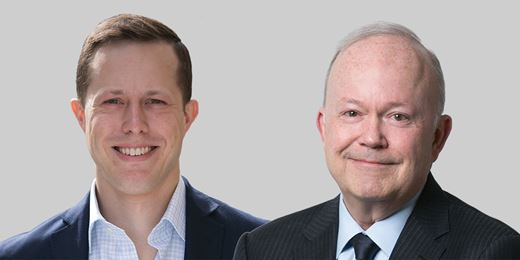
His son Patrick O'Shaughnessy is also a well-known investor with 260,000 Twitter/X followers.

Still, "Dead Investors Perform Best" Works Well as an Allegory
While we've found no clear data-backed evidence, the "dead investors perform best" theory still works brilliantly as an allegory and cautionary tale.
- Panic selling during market downturns
- Repeatedly "buying high and selling low" due to cognitive biases that favor avoiding losses over securing gains
- Accumulating fees from frequent trading
In investing, taking action often backfires.
"Do nothing" is one of the most commonly shared pieces of investment advice, and the "dead investors perform best" story is catchy and effective for conveying this message concisely.
Research: "Frequent Trading Reduces Performance"
While different from the "dead investors perform best" claim, there are several well-known studies on how frequent trading reduces performance.
Brad M. Barber and Terrance Odean, "Trading Is Hazardous to Your Wealth: The Common Stock Investment Performance of Individual Investors," The Journal of Finance, 2000.
https://faculty.haas.berkeley.edu/odean/papers%20current%20versions/individual_investor_performance_final.pdf
This is a highly cited paper with 4,954 citations to date. It analyzed 66,465 households with accounts at a major discount broker from 1991 to 1996, demonstrating that frequent traders significantly underperformed the market average.
Of 66,465 households with accounts at a large discount broker during 1991 to 1996, those that trade most earn an annual return of 11.4 percent, while the market returns 17.9 percent. The average household earns an annual return of 16.4 percent
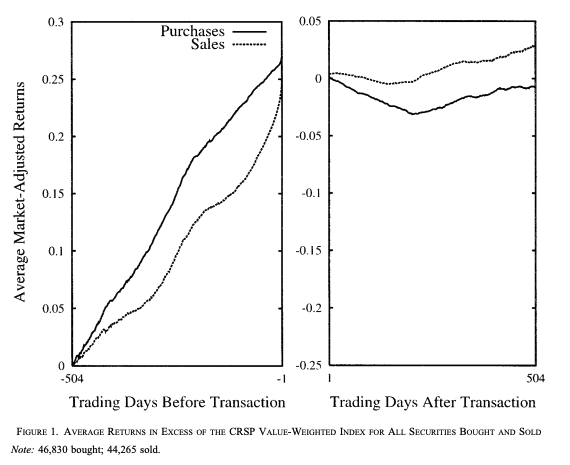
Terrance Odean, "Do Investors Trade Too Much?" The American Economic Review, 1999.
https://faculty.haas.berkeley.edu/odean/papers%20current%20versions/doinvestors.pdf
This is another highly cited paper (3,477 citations). This study demonstrates that stocks investors sold tend to outperform the stocks they purchased to replace them.
Conclusion
Summary of this article:
- The origin of the "dead investors perform best" theory is O'Shaughnessy's 2014 statement
- What he actually said was "investors who forgot they had an account perform best"
- The Fidelity study cited as evidence cannot be confirmed to exist
- Researches exist showing that "frequent trading reduces performance"
- Nevertheless, "dead investors perform best" works brilliantly as an allegory and cautionary tale
